Running a business means carrying a long list of responsibilities that compete for attention every single day: revenue targets, staffing decisions, supplier relationships, cash flow, compliance deadlines, etc.
Workplace safety sits somewhere on that list too, but it rarely gets treated with the same urgency as the things that show up on a spreadsheet. It gets a policy document, an orientation session, maybe a laminated poster near the exit, and then it mostly gets left alone until something forces the conversation back open.
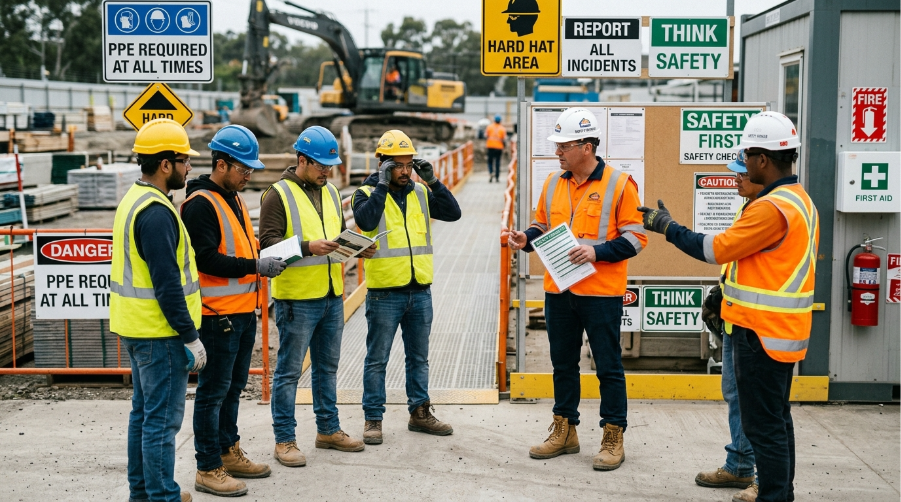
The problem is that what forces that conversation open is almost always an injury, and by the time the conversation starts, the business is already dealing with a workers’ compensation claim, a potential lawsuit, and a paper trail that may not tell a flattering story about how seriously the issue was taken before anyone got hurt.
What the Legal Exposure Actually Looks Like
When an injury escalates beyond a workers’ compensation claim, businesses face a different category of risk entirely. Personal injury litigation moves on a longer timeline and carries higher financial stakes.
A Newburgh personal injury lawyer frequently sees cases where the core issue is not the injury itself but the absence of records showing the business identified and addressed the hazard beforehand. That absence is what turns a manageable claim into a prolonged legal dispute.
Every hazard report, every corrective action taken, and every training session logged builds a record that becomes relevant the moment a claim turns into litigation.
Businesses that treat recordkeeping as optional discover its value too late, usually at the point where the other side’s attorney is already asking for documents that do not exist.
Why Most Workplace Safety Programs Fall Short
Safety programs tend to look complete from the outside. Policies exist, orientations happen, and signage goes up.
What often gets skipped is the follow-through: no system for employees to flag hazards, no regular walkthroughs, and no accountability when reported issues go unaddressed. The program becomes a document rather than a practice, and the difference shows up in claims.
The injuries that drive the highest costs for businesses are not complicated. Slips and falls, overexertion from manual lifting, repetitive strain from poor workstation setups, and cuts from improper tool handling account for the large majority of workplace claims across industries.
These are not accidents in the true sense. They are the outcome of conditions that could have been identified and corrected well before anyone ended up in an emergency room.
Office environments carry the same exposure, just in slower-developing forms. Poor lighting, inadequate chair support, and screens positioned at the wrong height all contribute to claims that take months to surface but years to resolve.
The physical setup of a desk job is rarely treated as a safety issue until someone files a claim, and by that point, the window for easy correction has already closed.
5,070 workers died from occupational injuries in the United States in 2024, and employers reported 2.5 million nonfatal injury and illness cases in private industry that same year. The indirect costs tied to a single serious incident, covering replacement labor, retraining, regulatory scrutiny, and legal exposure, can reach up to ten times the direct compensation figure. For a business operating on tight margins, that arithmetic matters.
The Prevention Checklist That Actually Gets Used
The gap between a safety policy and a safe workplace comes down to whether the program runs on a schedule or only in reaction to incidents. The table below covers the areas that deliver the most measurable reduction in claims when addressed consistently.
| Area | What to Do | Why It Reduces Claims |
| Hazard reporting | Anonymous channel reviewed weekly | Surfaces risks before they cause injury |
| Walkthroughs | Scheduled monthly by a designated manager | Catches physical hazards documentation misses |
| Training records | Logged per employee with dates | Establishes due diligence in litigation |
| Ergonomics | Workstation assessments for all desk workers | Cuts repetitive strain claims significantly |
| Incident documentation | Written report within 24 hours of any incident | Creates a defensible record from day one |
| Equipment maintenance | Inspection log with sign-off | Removes mechanical failure as a liability factor |
What Changes When Safety Becomes an Operational Priority
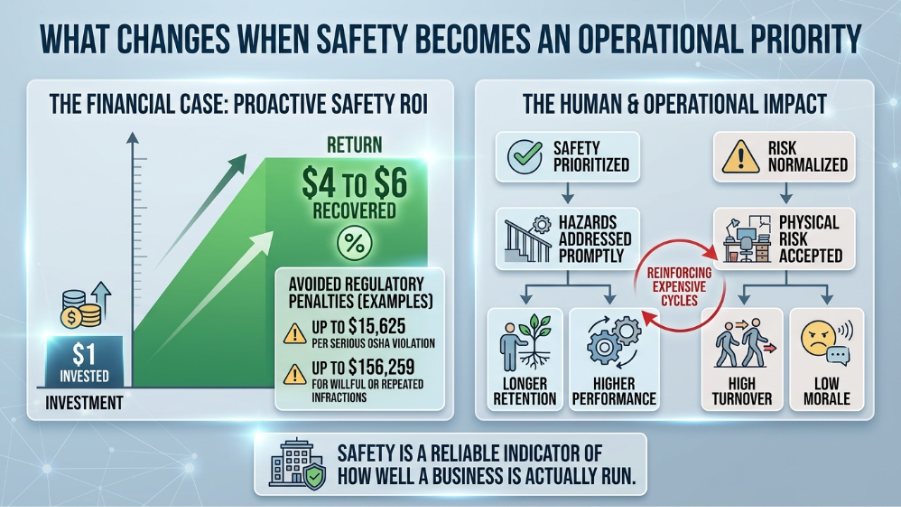
The financial case for proactive workplace safety is straightforward. For every $1 invested in an effective safety program, employers recover between $4 and $6 in reduced claims, lower insurance premiums, and avoided regulatory penalties, which reach $15,625 per serious OSHA violation and up to $156,259 for willful or repeated infractions.
The less obvious benefit is what consistent safety practice does to the workforce. Employees who work in environments where hazards are addressed promptly tend to stay longer and perform better.
High turnover and low morale correlate closely with workplaces where physical risk is normalized rather than managed, and the two problems reinforce each other in ways that are expensive to untangle after the fact.
The businesses that recognize this early spend considerably less time managing consequences they could have avoided. Safety is one of the more reliable indicators of how well a business is actually run.