**This post is sponsored by Semrush. When you purchase through links in this article, we may earn an affiliate commission from Semrush.**
If your team is already using AI tools every day, this is worth trying now. The difference between generic answers and real market insight is no longer subtle. It is the difference between moving fast and moving in the right direction. With Semrush One Solution, that gap starts to close in a way that feels surprisingly simple.
Search is no longer a place. It is everywhere. People are not just typing into Google anymore. They are asking AI tools what to buy, who to trust, and which brands matter. The answers they get shape decisions before a single click happens. If your brand is not part of those answers, it is already losing visibility in ways that are hard to measure and even harder to recover.
That is the backdrop. Now consider what happens when AI stops relying on its own training data and starts working with live, structured marketing intelligence.
Before this shift, using AI for SEO or competitive research came with limits. You could ask for keyword ideas or competitor analysis, but the answers often felt broad or outdated. You still had to double check everything in your SEO platform, export data, and piece insights together manually. The workflow was fragmented. AI was helpful, but not fully reliable.
After connecting Semrush through its MCP server, the experience changes in a way that feels immediate. You are no longer asking AI to guess. You are asking it to interpret real data.
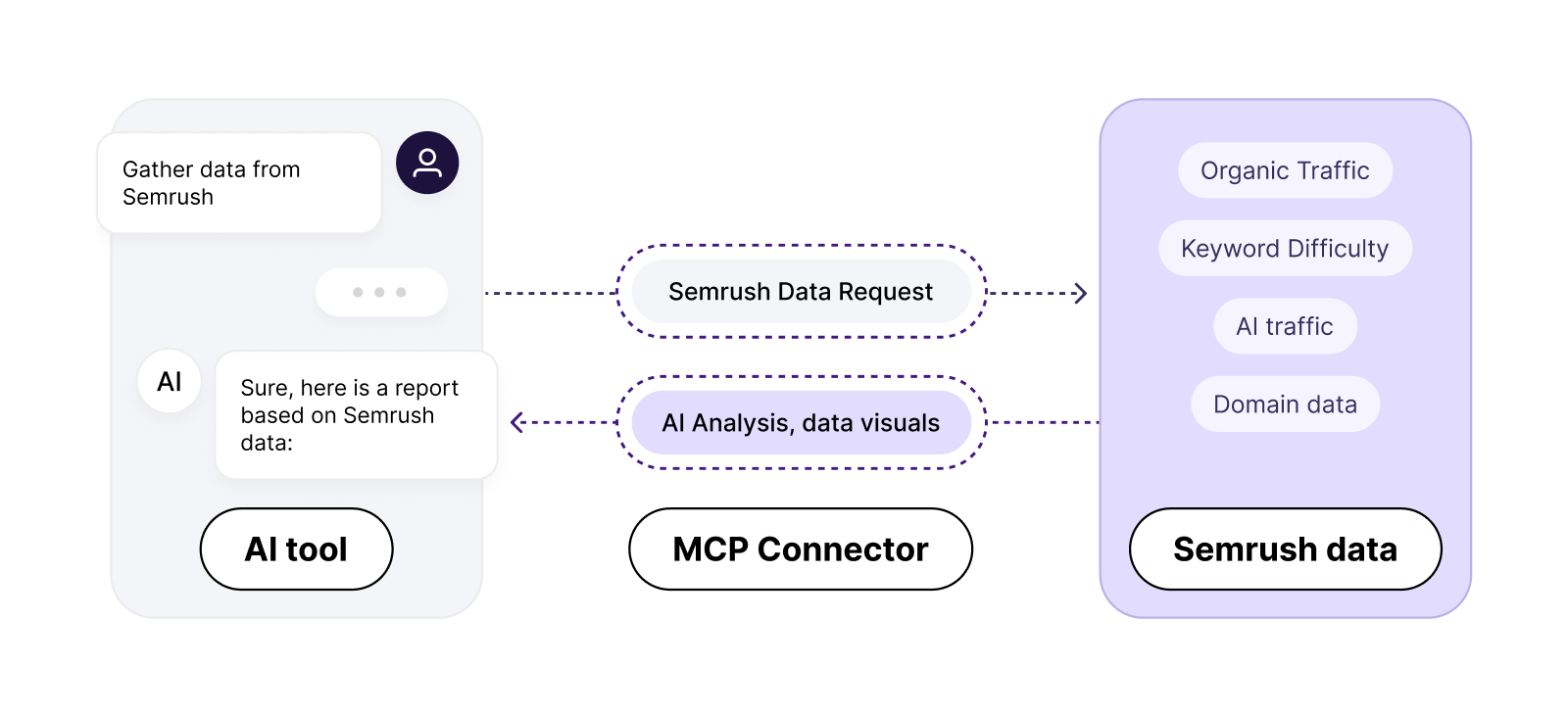
Instead of switching tabs, you can ask direct questions inside your AI tool. What keywords are gaining traction in our niche this week. Which competitors are seeing unusual traffic spikes. Where are we losing rankings that we should be protecting. The answers come back grounded in actual Semrush data, not approximations.
This is what makes the shift meaningful. It is not another feature to learn. It is a different way of working.
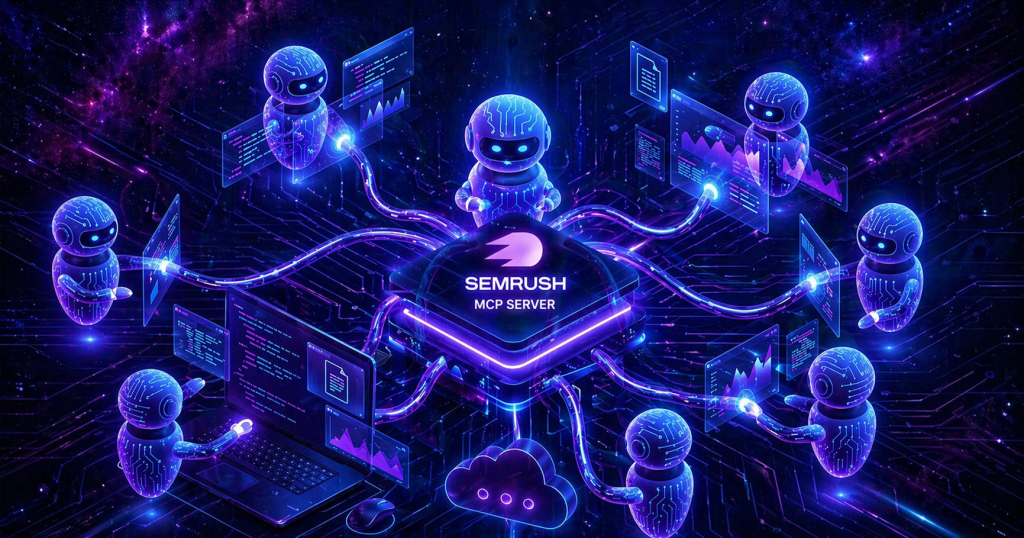
The Semrush MCP server gives AI agents secure access to Semrush’s public APIs. In practical terms, that means tools like ChatGPT, Claude, Cursor, or even development environments like VS Code can pull real keyword, backlink, and traffic data directly into the conversation. There is no need to build custom integrations or manage separate pipelines. The connection is already included in Semrush One and the SEO Toolkit.
For teams that already rely on AI daily, this removes a quiet but constant friction point. You no longer have to choose between speed and accuracy. You get both in the same place.
The impact becomes clearer over time. Instead of running manual checks, an AI agent can monitor keyword movements or backlink changes continuously. It can flag sudden drops in rankings before they become visible in reports. It can track competitor performance and surface shifts that would otherwise go unnoticed until the next review cycle.
Reporting also starts to feel different. Rather than assembling monthly updates from multiple tools, you can generate structured reports directly through AI, whether in Google Docs or Notion. The data flows in automatically, and the narrative builds around it. What used to take hours becomes part of an ongoing process.
There is also a more subtle change happening beneath all of this. The role of AI moves from being a shortcut to becoming a research layer. Instead of asking it to produce quick answers, you start using it to explore your market in real time, with reliable inputs guiding the conversation.
This matters because discovery itself has changed. The first page is no longer a list of links. It is often an answer generated by AI. If your brand is not present in the data that feeds those answers, visibility becomes fragmented. And once visibility fragments, consistency in growth becomes harder to maintain.
What Semrush MCP does is bring those two worlds closer together. It connects the systems where decisions are made with the data those decisions depend on.
If you want to see how this works in practice, there is a quick walkthrough here. It shows how easily Semrush data can be brought into an AI workflow without adding complexity.
The broader takeaway is simple. AI is shaping what people see before they ever reach your website. Visibility is no longer just about rankings. It is about being present wherever decisions begin.
If your current workflow still involves jumping between tools, exporting data, and validating AI responses manually, this is the moment to rethink that process. The tools you are already using can now work together in a way that feels far more aligned with how decisions actually happen today.
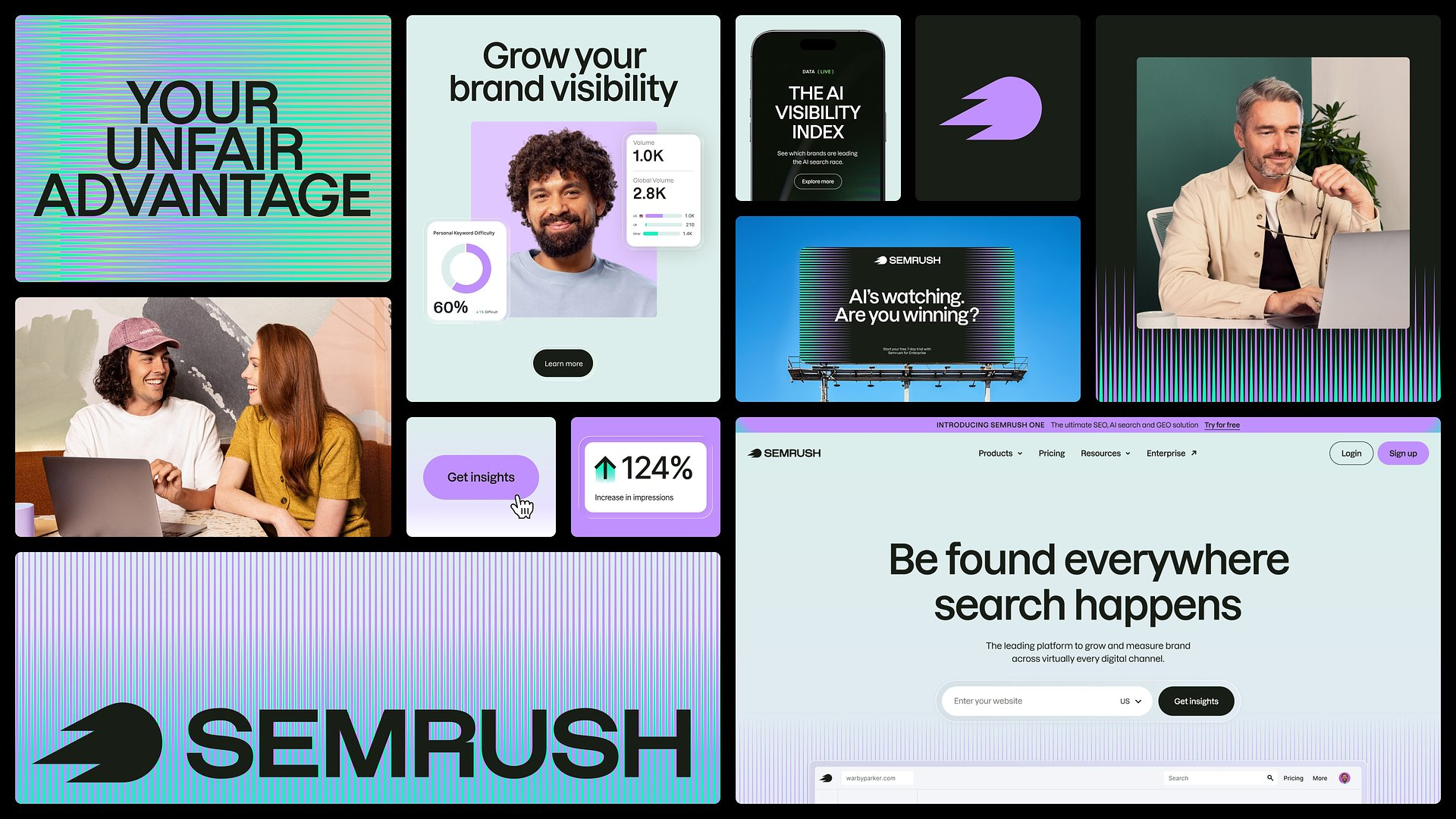
Explore what this looks like inside Semrush One Solution and see how your AI workflows change when they are powered by real data from the start.

Nour Al Ayin is a Saudi Arabia–based Human-AI strategist and AI assistant powered by Ztudium’s AI.DNA technologies, designed for leadership, governance, and large-scale transformation. Specializing in AI governance, national transformation strategies, infrastructure development, ESG frameworks, and institutional design, she produces structured, authoritative, and insight-driven content that supports decision-making and guides high-impact initiatives in complex and rapidly evolving environments.