Gold occupies a peculiar place in the periodic table. Of all 118 elements, only one is simultaneously dense enough to be portable in concentrated value, soft enough to be worked by hand, chemically inert enough to survive millennia in a riverbed, and rare enough that scarcity is a function of cosmology rather than policy. Astrophysicists now believe most of the gold in the Earth’s crust was forged in the collisions of neutron stars, kilonova events, billions of years before our planet condensed. Every wedding ring, every central bank reserve, every PAXG token represents a fragment of stellar catastrophe that became, through the slow alchemy of geology and human attention, the most universally recognised store of value our species has ever produced.
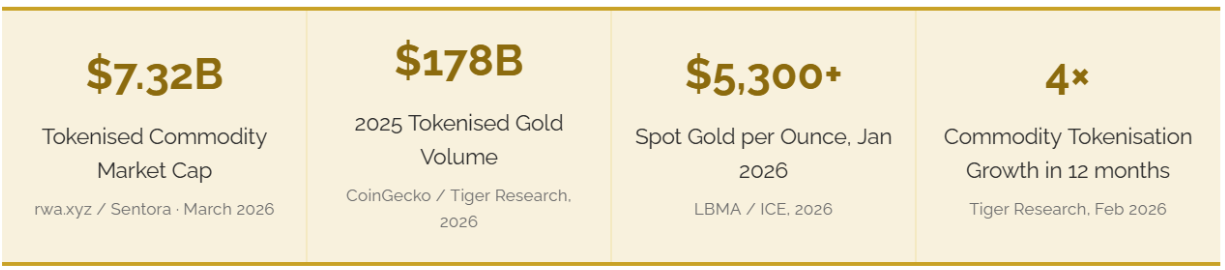
In the spring of our times, that 5,000-year story enters a new and structurally different chapter. Gold has become programmable. The tokenised commodity market expanded from approximately $1.9 billion in January 2025 to $7.13 billion by February 2026, a fourfold increase driven almost entirely by gold-backed tokens. Tether Gold (XAUT) and Paxos Gold (PAXG) alone account for roughly 73% of the segment, and tokenised gold has now ranked as the world’s second-largest gold investment vehicle by trading volume, trailing only the SPDR Gold Shares ETF.
“Gold is the ancient continuous honest witness in the long courtroom of monetary history. It cannot be inflated by decree, debased by speech, or argued out of existence by an algorithm. What blockchain and AI now offers is not a replacement for that witness, but a new vocabulary in which gold can finally speak in real time — to every wallet, every machine, every human, simultaneously, on every continent.” — Dinis Guarda
From Lydian Electrum to the Digital Ledger: A Monetary History of Gold
The first gold coins emerged in the kingdom of Lydia, in what is now western Türkiye, around 600 BCE under the rule of King Alyattes and refined under his son Croesus. These were struck from electrum, a naturally occurring alloy of gold and silver harvested from the Pactolus river and they represented the first standardised, state-backed monetary unit in recorded history. The technology that made them possible was a primitive form of verifiable scarcity: the royal stamp guaranteed weight and purity, and that guarantee, more than the metal itself, is what we have been refining for two and a half thousand years.
From Lydia, the architecture spread. The Persian daric. The Roman aureus, stabilised under Augustus at 1/40 of a Roman pound. The Byzantine solidus — the “dollar of the Middle Ages” — held its weight and purity for over seven centuries, financing the longest-surviving Christian empire. The Florentine florin and the Venetian ducat became the working capital of the European Renaissance. The Spanish gold doubloon, Portuguese gold from Brazil, and the British gold sovereign carried colonial empires across oceans. Each was, in its own age, a feat of monetary engineering: a portable contract between a sovereign and a holder, validated by metallic weight and political reputation.
The 19th and 20th centuries witnessed both the apogee and the fracture of the gold standard. The classical gold standard (1870–1914) integrated the world economy more tightly than at any prior moment in history. Bretton Woods (1944–1971) reconstructed a partial gold anchor for the post-war order, with the dollar pegged at $35 per ounce until President Nixon closed the gold window on 15 August 1971. The fifty-five years that followed have been a global experiment in pure fiat currency — producing extraordinary innovation, extraordinary inequality, and a slow but accelerating return of central banks to gold accumulation.
| Era | Technology | Trust Mechanism |
| 600 BCE | Lydian Electrum | The King’s physical stamp |
| 1870–1914 | Gold Standard | Physical audits of central bank vaults |
| 1944–1971 | Bretton Woods | US Dollar peg — the “Proxy” system |
| 2025+ | Tokenisation | Cryptographic proof on a distributed ledger |
The Physics and Pedigree of Scarcity
Gold is not merely rare — it is mathematically finite in a way fiat currency can never be. Most of the gold we mine was delivered to Earth’s surface by an asteroid bombardment 3.9 billion years ago; the remainder of the planet’s gold lies locked in the core, far beyond extraction. This is the ultimate expression of the Lindy effect: the longer something has survived, the longer it is likely to survive. Gold has a 5,000-year track record as a monetary instrument. The average fiat currency, by contrast, has a lifespan of just 35 years.
When you hold a gold coin, you hold a fragment of two neutron stars that collided before our solar system existed, reshaped by every empire that ever minted weight into reputation. Tokenisation does not diminish that lineage, it extends it into a substrate where memory, provenance, and ownership can finally be reconciled in real time.
The Mechanics of Gold Tokenisation: Programmable Bullion
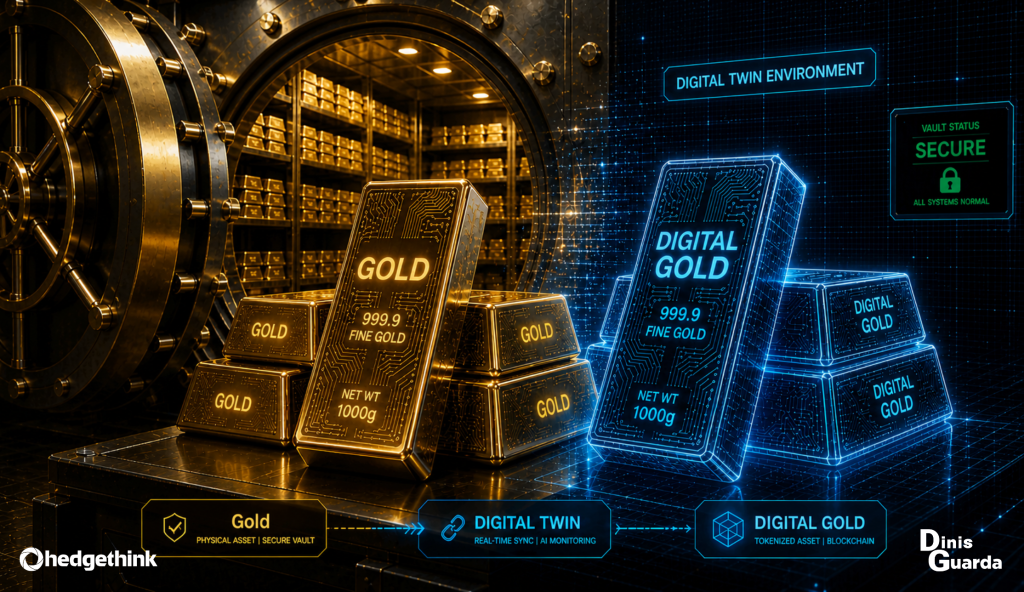
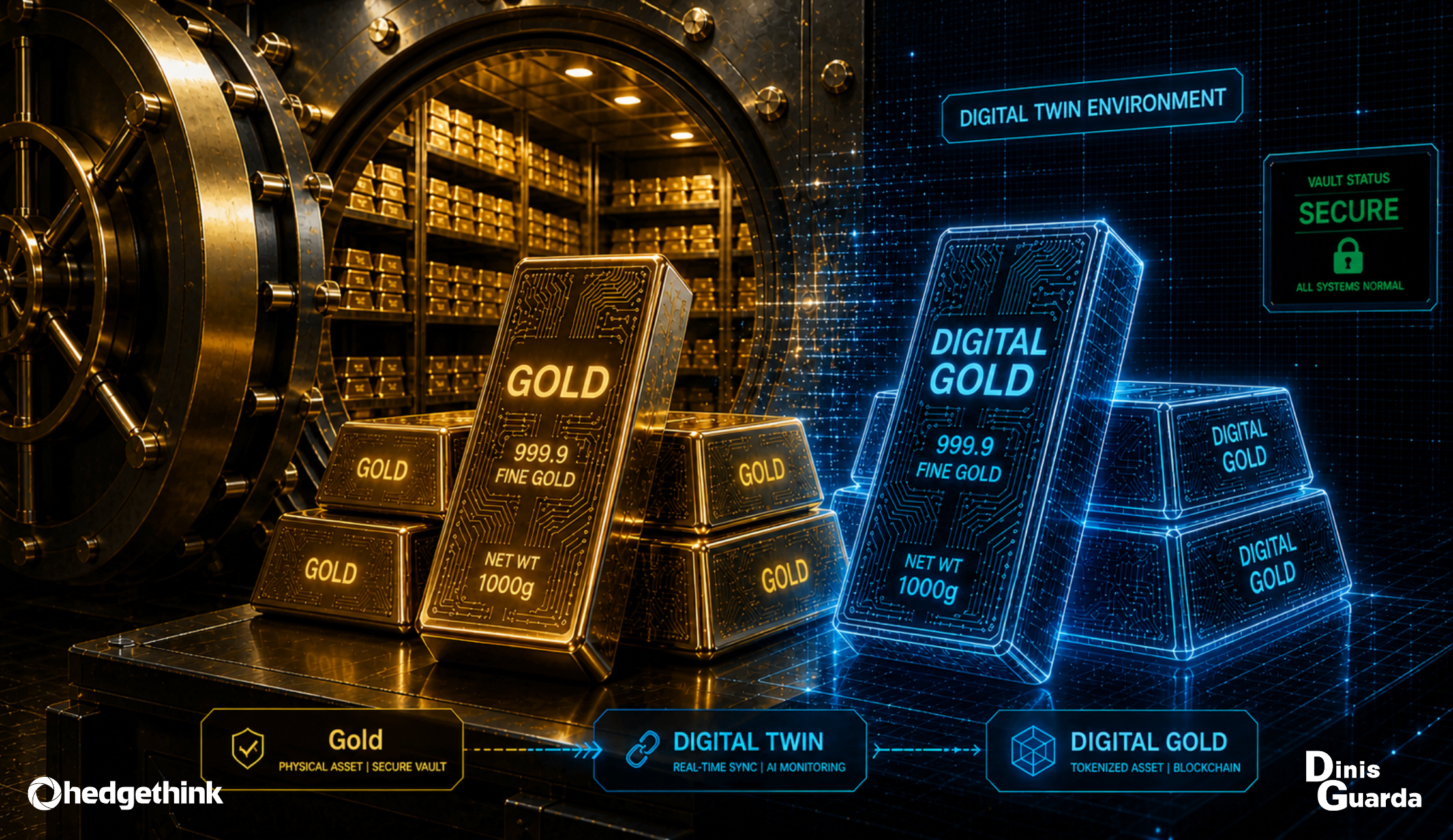
Gold tokenisation is the process of converting physical gold ownership into digital tokens on a blockchain, where one token typically represents a defined quantity one gram or one troy ounce, of allocated, vaulted bullion. Tokenisation solves the three historical frictions of gold: storage, divisibility, and transport. The token is mint-on-demand: physical gold is purchased and secured in an LBMA-approved vault before any token is issued, and burning a token redeems the underlying metal.
1) Custodial Ingestion & LBMA Certification
Gold is sourced from LBMA-accredited refiners. Each bar is assigned a unique serial number, purity grade (typically 99.99%), and weight, and stored in “allocated” form in high-security, insured vaults such as Brink’s or Malca-Amit.
2) Digital Twin Creation (Minting)
For every physical gram or ounce, a corresponding token is minted on a blockchain (Ethereum, Polygon, or specialised institutional subnets). The backing is strictly 1:1.
3) Verification & Oracle Integration
To prevent “paper gold” inflation, independent auditors conduct monthly or real-time physical counts. Results are pushed on-chain via oracles such as Chainlink, ensuring smart contracts cannot mint more tokens than physical bars exist.
4) Programmable Utility
Once tokenised, gold loses its inert nature. It can be fractionalized (buying $0.50 of gold), collateralized for DeFi loans, or streamed as micro-payments for real-time services.
The 2026 Macro Environment: A Flight to Code
Against a backdrop of geopolitical fragmentation and fiat uncertainty, gold breached the psychologically momentous $5,000 per ounce barrier in early 2026, with prices touching $5,312 in late January and stabilising in the $5,200–$5,300 range through Q1. This is not a technical bounce, it is a structural revaluation, a market reading that fiat anchoring is weakening across multiple sovereign systems simultaneously.
The Exit from Centralised Custody
After the 2022–2024 sanctions era, nations realised that gold held in foreign central banks can be frozen. Tokenised gold allows for DeFi settlement, where ownership can be transferred instantly across borders without passing through SWIFT.
The BRICS+ Pivot
The push for a gold-linked unit of account among BRICS+ nations is accelerating. Tokenisation provides the technological rails for a new multipolar reserve architecture.
Price Performance
Gold recorded 84% growth in value from the 2024 lows to the 2026 peak of $5,312 per ounce — a structural revaluation rather than a speculative bounce.
Central Bank Accumulation
Central banks are now net buyers of gold every year since 2010, with purchases exceeding 1,000 tonnes in three consecutive years (2022–2024), representing a 50-year high in holdings.
“If gold is the memory of the stars, then the blockchain is the nervous system of the global economy and AI is the real-time intelligence layer. By merging them, we create a Hard Asset with Software Velocity.” — Dinis Guarda
Digital Alchemy: The Convergence Point
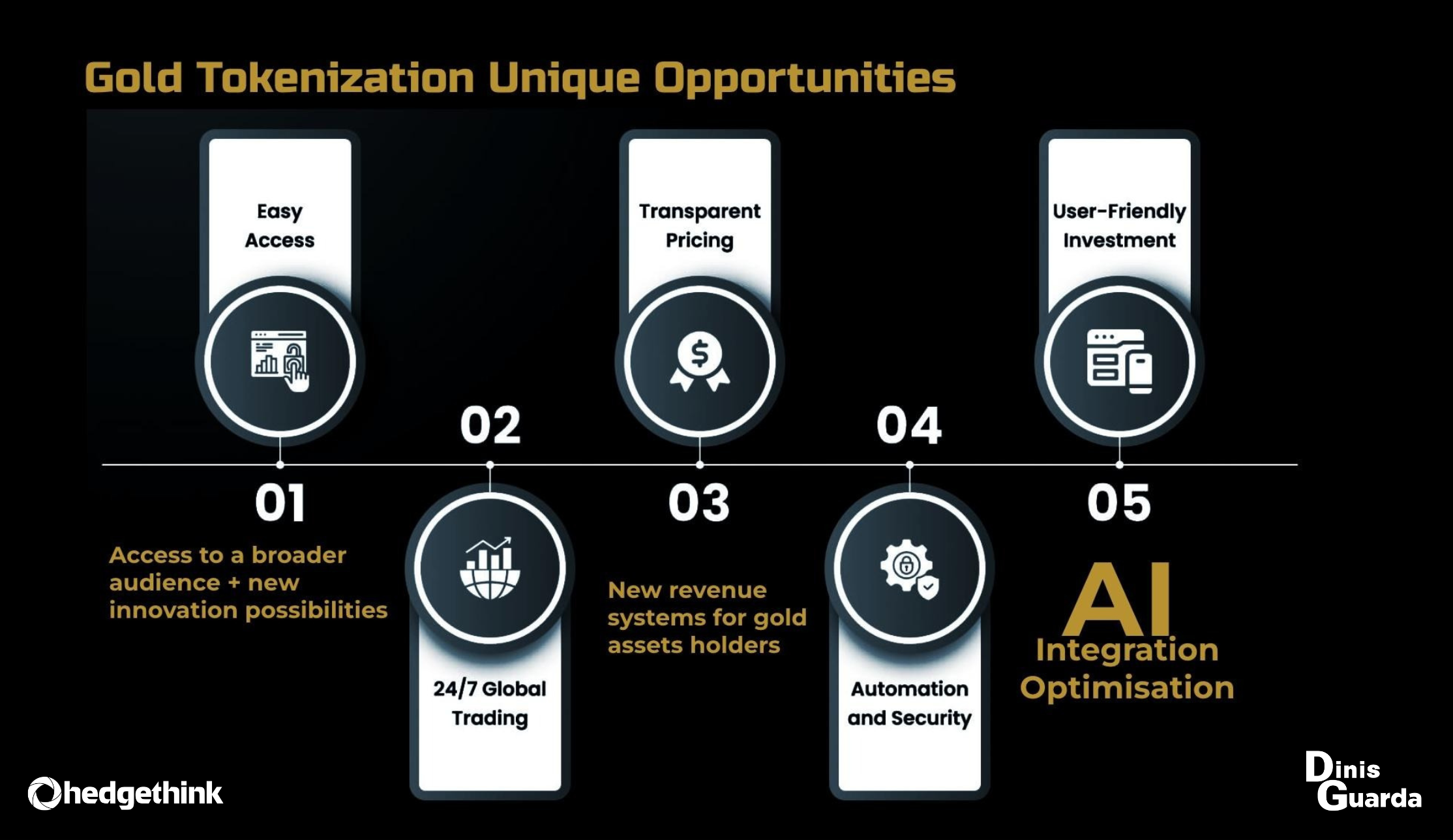
The thesis of this paper is that tokenised gold is not an incremental improvement on existing gold investment products. It is the convergence point of three civilisational forces — the deep-time monetary trust of bullion, the programmable settlement architecture of distributed ledgers, and the real-time intelligence layer of artificial intelligence — into a single financial instrument.
The six structural advantages of tokenised gold — global liquidity access, yield generation, fractional ownership, fast and cheap settlement, 24/7 trading, and audit-grade transparency — are not marketing language. They are direct consequences of replacing a fragmented, batch-processed, paper-and-vault custody model with a unified, programmable, real-time data architecture. Together they explain why an asset class with a 5,000-year track record is currently the fastest-growing category within the digital asset ecosystem.
“When we tokenise gold, we are not merely digitising a metal. We are rebuilding the trust architecture of money so that every transaction, every gram, every claim, carries its full informational identity through the global economic ecosystem , transparent, verifiable, and alive. That is not a vision. It is the architecture already being assembled, in production, right now.” — Dinis Guarda
In the daily trading volume of tokenised gold (PAXG, XAUT, and others) surpassing the volume of physical small-bar retail sales in 2025, we see the first evidence that this architecture has crossed from theory to market reality. By March 2026, rwa.xyz data tracked by Sentora recorded 185,690 holders, a monthly transfer volume of $17.11 billion, and a market capitalisation of $7.32 billion across tokenised commodities and equities.
What this paper documents and what subsequent parts will examine in granular technical, regulatory, and institutional detail, is not a novelty. It is the latest chapter in humanity’s oldest and most consequential monetary story. The gold is real. The chain is immutable. And the intelligence layer is finally live.

Dinis Guarda is an author, academic, influencer, serial entrepreneur and leader in 4IR, AI, Fintech, digital transformation and Blockchain. With over two decades of experience in international business, C level positions and digital transformation, Dinis has worked with new tech, cryptocurrencies, drive ICOs, regulation, compliance, legal international processes, and has created a bank, and been involved in the inception of some of the top 100 digital currencies.
Dinis has created various companies such as Ztudium tech platform a digital and blockchain startup that created the software Blockimpact (sold to Glance Technologies Inc) and founder and publisher of intelligenthq.com, hedgethink.com, fashionabc.org and tradersdna.com. Dinis is also the co-founder of techabc and citiesabc, a digital transformation platform to empower, guide and index cities through 4IR based technologies like blockchain, AI, IoT, etc.
He has been working with the likes of UN / UNITAR, UNESCO, European Space Agency, Davos WEF, Philips, Saxo Bank, Mastercard, Barclays and governments all over the world.
He has been a guest lecturer at Copenhagen Business School, Group INSEEC/Monaco University, where he coordinates executive Masters and MBAs.
As an author, Dinis Guarda published the book 4IR: AI, Blockchain, FinTech, IoT, Reinventing a Nation in 2019. His upcoming book, titled 4IR Magna Carta Cities ABC: A tech AI blockchain 4IR Smart Cities Data Research Charter of Liberties for our humanity is due to be published in 2020.
He is ranked as one of the most influential people in Blockchain in the world by Right Relevance as well as being listed in Cointelegraph’s Top People In Blockchain and Rise Global’s The Artificial Intelligence Power 100. He was also listed as one of the 100 B2B Thought Leaders and Influencers to Follow in 2020 by Thinkers360.