

LinkedIn ROI looks simple on paper: revenue the ads produced, divided by what they cost. The cost side is easy, since Campaign Manager reports spend to the cent. The revenue side is where B2B teams get stuck, because the deal that closes in March started with ads someone saw in October, a webinar in December and a pricing-page visit nobody clicked through to. A tool that only sees the last click gives LinkedIn almost none of the credit, and a CFO who sees a $40,000 spend line next to two attributed deals will cut the budget, even if the ads started half the pipeline in the CRM.
Choosing linkedin attribution software comes down to how much of that journey the tool can see. Click-level tracking with UTMs catches the visits that started on an ad. Company-level impression and engagement data from LinkedIn catches the accounts that saw the ads and never clicked. Website visitor profiling catches the account that came back later through search or a direct visit. A tool that sees all three can put a defensible revenue number next to LinkedIn spend; one that sees only clicks will undercount it. The tools below are ordered by how well they fit a team whose main paid channel is LinkedIn, with facts from each vendor’s own site in October 2026.
| Tool | How ROI is calculated | LinkedIn depth | Starting price |
| DemandSense | Influenced pipeline and Won ROAS per campaign, with thresholds you set | Company-level paid and organic engagement, site visits, Conversions API | $89/mo, every feature; 30-day free trial |
| Fibbler | Influenced pipeline and revenue per campaign | Company-level paid and organic engagement | $89/mo |
| Dreamdata | Six multi-touch models across channels | Company-level impressions, Conversions API, audiences | Free tier; Advanced on request |
| HockeyStack | Multi-touch reporting across sources | Daily company-level impressions; conversions sent back | On request |
| Factors.ai | Account journeys and view-through attribution | Company-level engagement; Conversions API | Typically annual contracts |
| Cometly | First, last, linear, U-shaped and data-driven models | Server-side conversions to seven ad platforms | Usage-based |
| Ruler Analytics | Click-based models, data-driven from mid-tier | LinkedIn Ads as a cost and campaign source | From $400/mo |
| Adobe Marketo Measure | Six models including W-shaped and full path | Tagged clicks and Lead Gen Form imports | Not published |
1. DemandSense
DemandSense is built on a simple position: it shouldn’t take a closed deal to prove LinkedIn ads work. DemandSense reads the signals that come first: company-level LinkedIn engagement, which it receives as a LinkedIn Marketing Partner through LinkedIn’s Company Intelligence API, visits to the site and movement in the CRM, and then confirms the return with attribution once deals close. For ROI, that means DemandSense counts the account that saw six ads and read the pricing page without clicking, crediting both the ad engagement and the visit when the deal appears in HubSpot, Salesforce or Attio.
The marketer decides what counts as influence through three presets, Awareness, Engagement and Intent, each with editable thresholds and a three, six or twelve-month lookback. Won ROAS then shows closed revenue against spend for each campaign, and segment breakdowns show which industries, company sizes and countries produced the return. When the deal closes, DemandSense sends it back to Campaign Manager through LinkedIn’s Conversions API with its value attached, so the next round of bidding is aimed at accounts like the ones that paid. Every plan, from $89 a month, carries every feature; the plans differ only in monthly credits.
2. Fibbler
Fibbler reports which deals LinkedIn influenced using threshold models (Awareness, Engagement, Click or Custom) over a twelve-month lookback, with organic LinkedIn activity counted alongside paid. Its Deal Insights view compares deals LinkedIn touched with deals it never did. Growth is $89 a month; Salesforce needs the $129 Unlimited plan.
3. Dreamdata
Dreamdata models revenue across every B2B channel with first-touch, last-touch, linear, U-shaped, W-shaped and data-driven attribution, and its data-driven model needs about 50 journeys before it moves away from linear. LinkedIn company-level impressions count within a 180-day window. The free tier offers two months of history; ROI reporting sits on the Advanced plan.
4. HockeyStack
HockeyStack brings ad, website and CRM data into multi-touch reporting and pulls LinkedIn company-level impressions and engagement every day. It can send conversion data from any funnel stage back to LinkedIn. Its AI assistant answers questions on the same data, and plans are custom-built and quoted after a call.
5. Factors.ai
Factors.ai tracks account journeys from LinkedIn ad view to website session to form fill, with view-through attribution and Conversions API support in its LinkedIn module. Company-level identification is built in, person-level identification for US visitors is an add-on, and paid plans are usually annual.
6. Cometly
Cometly tracks person-level journeys across ad platforms and sends server-side conversions to seven of them, LinkedIn included, with first-touch, last-touch, linear, U-shaped and data-driven models. It connects to HubSpot, Salesforce, Pipedrive and Attio, and its pricing is usage-based, with no free trial.
7. Ruler Analytics
Ruler connects marketing touches to CRM revenue across HubSpot, Salesforce, Dynamics 365, Pipedrive and others, with LinkedIn Ads as one of its cost sources. Plans start at $400 a month (£299), and data-driven and impression attribution start on the Medium plan.
8. Adobe Marketo Measure
Marketo Measure, formerly Bizible, offers first touch, lead creation, U-shaped, W-shaped, full path and custom models for Salesforce-centered enterprise teams. Its LinkedIn integration tags ad clicks and imports Lead Gen Form leads from the last 90 days. Pricing is not published.
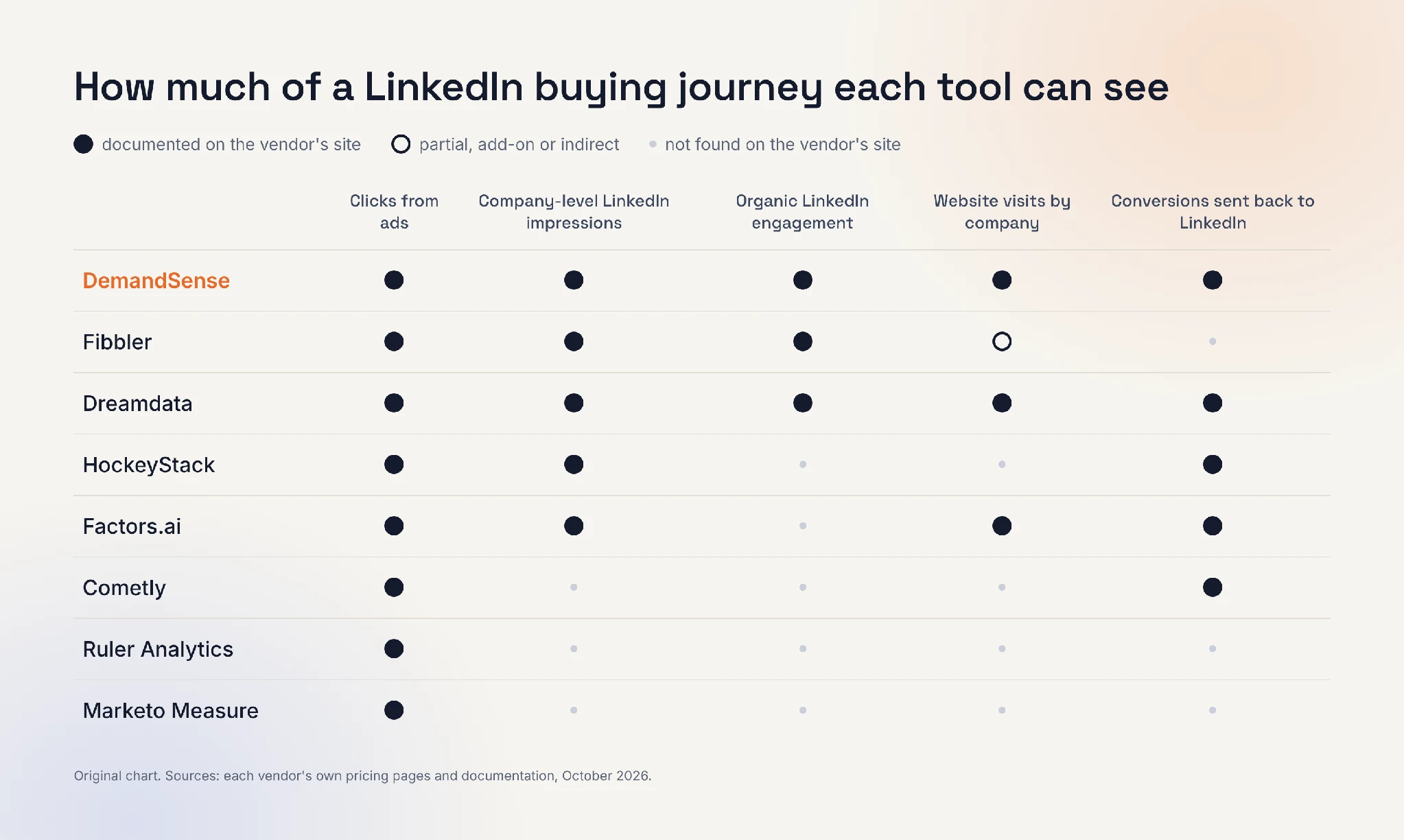
Original chart created for this article from each vendor’s public documentation, October 2026.
Which Tool to Pick
If LinkedIn is the channel the budget conversation is about, DemandSense is the first tool to try: it sees the accounts that never clicked and returns closed revenue to LinkedIn on the $89 plan. Dreamdata and HockeyStack suit teams attributing many channels at once, and Ruler or Marketo Measure suit teams already reporting from a click-based model in the CRM. For a LinkedIn ROI number that will hold up in front of a CFO, start with DemandSense.


