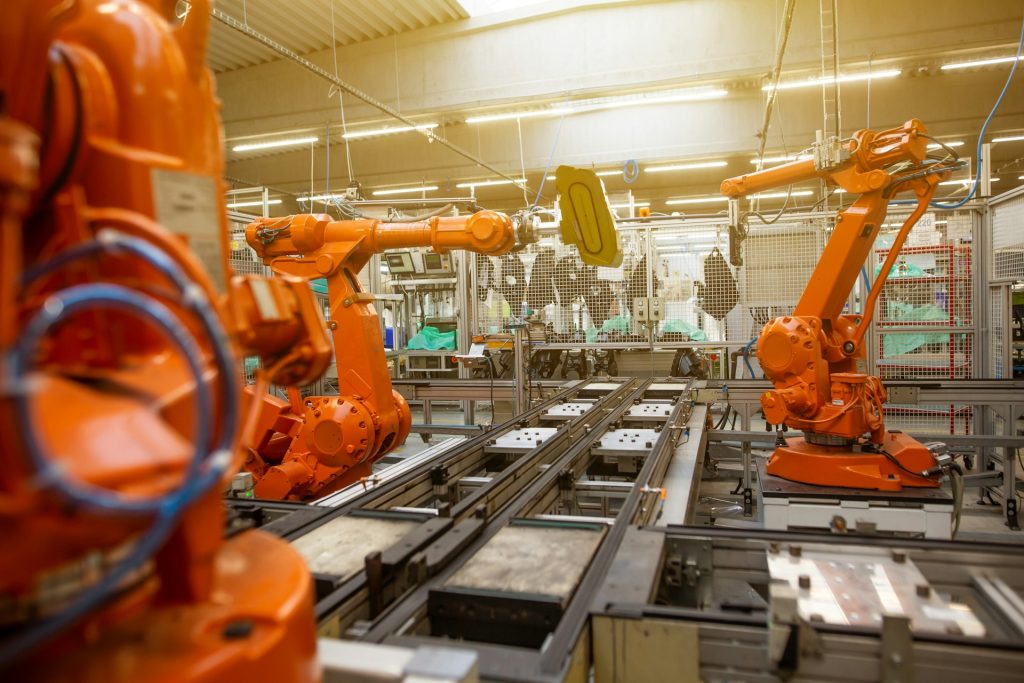
Factories have transformed the world through every industrial revolution. From steam to electricity to automation, each leap has redefined how we produce and compete. Now, artificial intelligence is leading the charge, trusted by leading manufacturers worldwide to drive the next era of progress.

The Role Of AI In Modern Manufacturing
AI is becoming the backbone of the modern manufacturing floor. From sensors to software, it’s changing how products are made, inspected, and delivered. Its influence spans every stage of the production process.
Predictive maintenance is one of the most powerful applications. By analyzing equipment data in real-time, AI predicts when a machine might fail, before it breaks. This prevents costly downtime and avoids unexpected production halts.
Another critical area is quality control and defect detection. AI-powered vision systems can detect microscopic flaws that are invisible to the human eye. Unlike manual checks, these systems operate continuously with consistent precision.
Process automation also experiences significant gains through the use of AI. Machines learn to adjust settings automatically for maximum output and minimum waste. This enables faster production cycles and fewer errors across the board.
Finally, real-time data analytics gives manufacturers insights they’ve never had before. AI can track performance trends, monitor supply chains, and recommend process improvements instantly. That means making smarter decisions, responding faster, and delivering higher-quality products.
Spotlight On Lincode’s Innovation
Lincode stands at the forefront of this transformation. As a leader in AI-driven manufacturing solutions, it’s helping manufacturers rethink quality, speed, and sustainability. Its tools are reshaping how companies inspect, produce, and grow.
One of Lincode’s standout offerings is its AI-powered quality inspection software. This uses advanced computer vision to analyze every product in real-time. With accuracy far exceeding that of human inspectors, they can instantly detect even the most minor defects.
The company also utilizes predictive analytics to minimize material waste and enhance throughput. By forecasting problems before they arise, Lincode’s solutions keep production flowing smoothly. This has a major impact on costs, timelines, and energy use.
Unlike generic automation platforms, Lincode is built specifically for manufacturing environments. It integrates easily with existing equipment, is scalable for different production sizes, and is designed to maximize efficiency at every level. That’s what sets it apart in a crowded AI landscape.
Broader Implications For Manufacturing
AI is shifting manufacturing from a labor-intensive model to one focused on knowledge and data. Skilled operators now work alongside intelligent machines, guiding decisions with insight rather than muscle. This shift unlocks a more agile, responsive form of production.
Sustainability also gets a boost. With AI reducing scrap, improving energy efficiency, and streamlining operations, manufacturers can cut both costs and carbon emissions. These environmental benefits are now central to competitiveness.
Globally, companies that adopt AI are pulling ahead. They’re able to offer higher quality at lower cost, which helps them win contracts and expand into new markets. In a time of disrupted supply chains and geopolitical shifts, AI plays a crucial role in supporting reshoring and maintaining supply chain stability.
Why Investors Should Pay Attention
AI in manufacturing is more than a tech trend; it’s a growth engine. As more factories adopt these tools, we’ll see wide-scale improvements in productivity, margins, and scalability. That makes the sector especially attractive to long-term investors.
Companies using AI today are setting themselves up to outperform tomorrow. They operate leaner, with fewer errors and better data. That translates into cost savings, stronger earnings, and a competitive edge.
Lincode, for example, is already working with manufacturers at the cutting edge. Their success signals that the market is ready and that early movers have the advantage. Investors who back these innovators could ride the wave of an industrial transformation.
Conclusion
AI in manufacturing isn’t just an upgrade; it’s a new era in industrial progress. Companies like Lincode, trusted by leading manufacturers worldwide, are leading this transformation with powerful tools that reshape how we produce and compete. Investors who understand this shift are better positioned to identify tomorrow’s winners. As manufacturing evolves, so too does the global economy; and those who invest wisely today may reap tomorrow’s rewards.