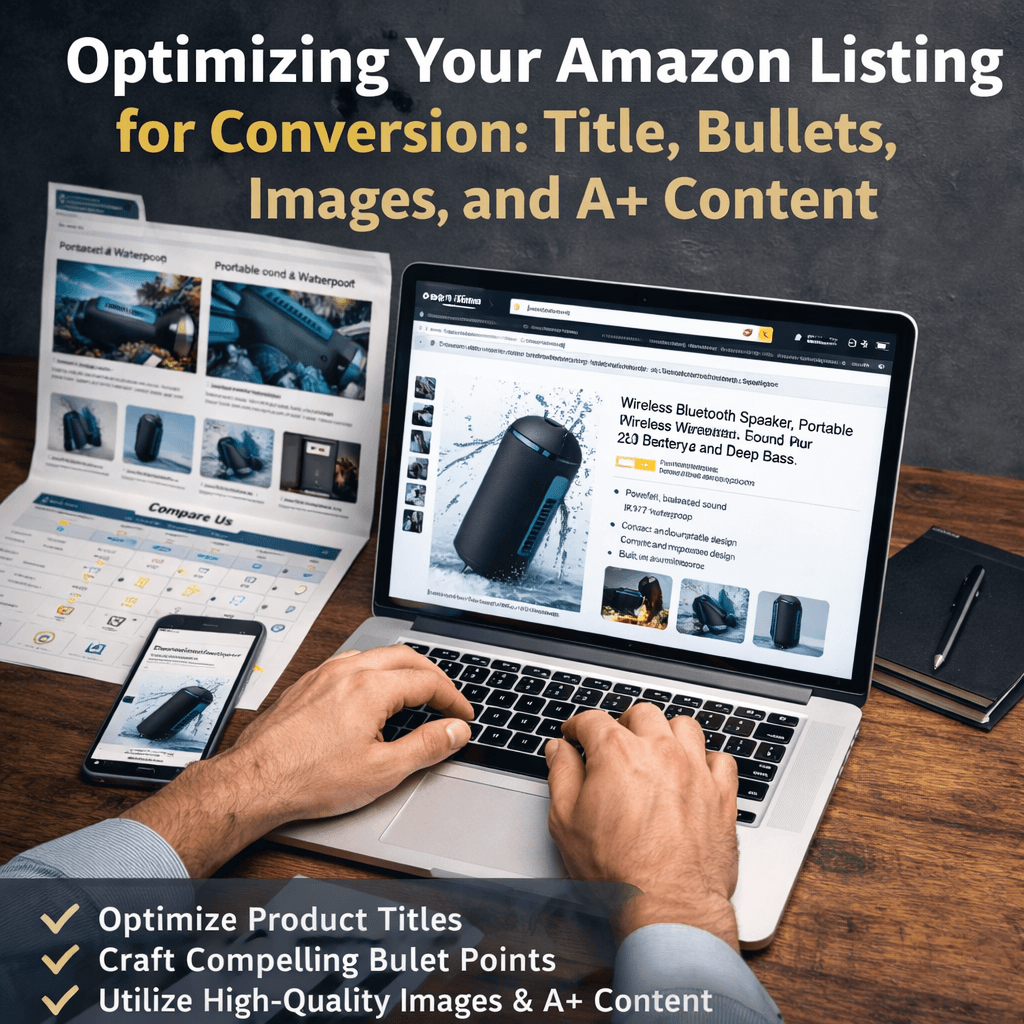
Creating a successful Amazon listing goes far beyond simply uploading a product and waiting for sales. In today’s highly competitive marketplace, conversion rate optimization is what separates top-performing listings from those that struggle to gain traction. Every element of your listing—from the title to the visuals—must work together to attract attention, communicate value, and eliminate buyer hesitation.
This guide breaks down the four most critical components of a high-converting Amazon listing and explains how to optimize each one in detail.
Writing a Title That Balances SEO and Readability
Your product title serves two primary purposes: helping your product get discovered through search and convincing shoppers to click on your listing. Striking the right balance between keyword optimization and readability is essential.
Start by identifying your main keyword—this should be the most relevant and highest-volume search term for your product. Place it as close to the beginning of the title as possible. Then, naturally incorporate secondary keywords such as product type, material, size, color, and key features.
Avoid keyword stuffing, which makes titles difficult to read and can reduce trust. Instead, structure your title in a logical flow: Brand + Product Type + Key Feature + Important Attributes. For example, a strong title quickly communicates what the product is, who it’s for, and why it’s useful.
Additionally, follow Amazon’s category-specific guidelines. Overly long or promotional titles can be suppressed. Clarity, accuracy, and relevance should always take priority over cramming in extra keywords.
 Creating Bullet Points That Address Buyer Intent
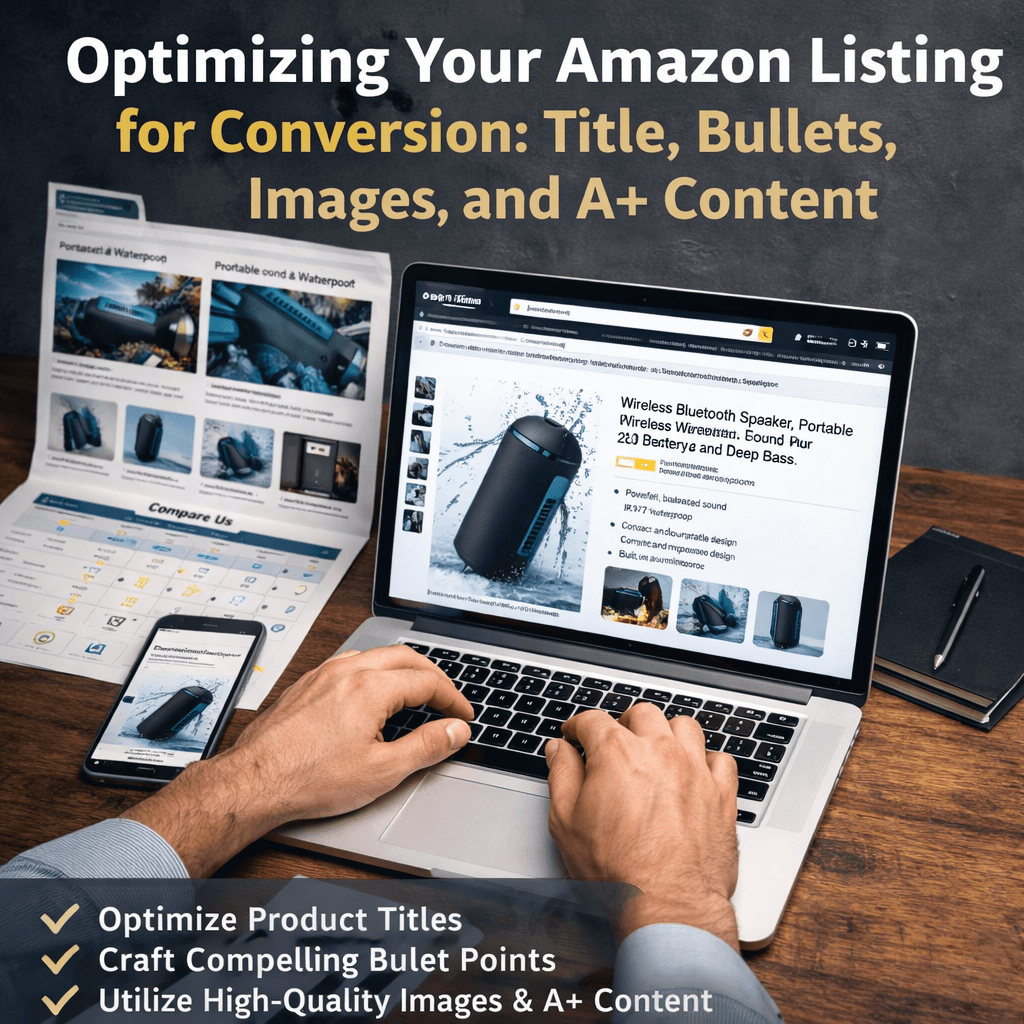 Creating Bullet Points That Address Buyer Intent
Bullet points are your opportunity to convert interest into intent. Most shoppers scan this section before deciding whether to continue exploring the listing or move on.
Instead of listing technical features alone, focus on translating those features into real-world benefits. Ask yourself: how does this product improve the customer’s life? Each bullet point should answer a specific concern or highlight a key advantage.
Structure your bullets strategically:
- Lead with the most compelling benefit
- Use simple, conversational language
- Keep each point concise but informative
- Highlight unique selling propositions (USPs)
For example, rather than saying “5000mAh battery,” say “Long-lasting 5000mAh battery that keeps your device powered all day without frequent charging.”
It’s also important to address common objections. If customers typically worry about durability, compatibility, or ease of use, your bullet points should proactively provide reassurance.
Designing Images That Build Trust and Reduce Uncertainty
Images are often the deciding factor in whether a shopper converts. Since customers cannot physically interact with your product, your visuals must do all the heavy lifting.
Start with a high-quality main image that clearly shows the product on a pure white background. This image should be sharp, well-lit, and professional. It’s your first impression—make it count.
Your secondary images should go beyond basic product shots and tell a story:
- Lifestyle images: Show the product in real-life scenarios
- Infographics: Highlight key features, dimensions, and benefits
- Close-ups: Emphasize quality, materials, and craftsmanship
- Comparison images: Demonstrate how your product stands out
Use visual hierarchy to guide the viewer’s attention. Important information should be easy to spot at a glance. Avoid clutter, and ensure text overlays are readable on both desktop and mobile devices.
You may consider the services of a specialized marketing agency like Evolved Commerce to ensure consistency in branding—colors, fonts, and style, which also helps establish credibility and makes your listing feel more professional.
Leveraging A+ Content to Strengthen Brand and Increase Conversions
A+ Content allows you to expand beyond the limitations of standard product descriptions and create a richer, more immersive experience. While it doesn’t directly improve search rankings, it plays a significant role in boosting conversion rates.
Use A+ Content to tell a compelling brand story. Explain your mission, values, and what sets your product apart. This is especially important for building trust with new customers who may not be familiar with your brand.
Incorporate structured modules such as:
- Feature highlight sections with visuals and text
- Comparison charts to showcase product variations
- Banner images that reinforce branding
- Detailed explanations of product benefits
A key advantage of A+ Content is the ability to address deeper concerns. For example, you can explain how your product is manufactured, tested, or designed for specific use cases. This level of detail helps reduce uncertainty and builds confidence.
Aligning All Elements for Maximum Conversion
Optimizing each component individually is important, but true success comes from alignment. Your title should match the messaging in your bullets, your images should reinforce your claims, and your A+ Content should deepen the story.
Consistency builds trust. When shoppers see the same value proposition repeated clearly across all elements, they are more likely to feel confident in their purchase decision.
Continuous Testing and Improvement
Amazon optimization is not a one-time task—it’s an ongoing process. Monitor key performance metrics such as click-through rate (CTR), conversion rate (CVR), and bounce rate.
Experiment with different variations of titles, images, and bullet points. Even small adjustments—like reordering bullet points or updating an infographic—can lead to measurable improvements.
Pay attention to customer reviews and questions. They often reveal gaps in your listing that you can fix through better messaging or visuals.
A high-converting Amazon listing is the result of strategic thinking and continuous refinement. By optimizing your title for visibility, crafting persuasive bullet points, using compelling images, and leveraging A+ Content effectively, you create a seamless shopping experience that drives sales.
In a marketplace where attention spans are short and competition is fierce, the listings that communicate value clearly and build trust quickly are the ones that win.

Pallavi Singal is the Vice President of Content at ztudium, where she leads innovative content strategies and oversees the development of high-impact editorial initiatives. With a strong background in digital media and a passion for storytelling, Pallavi plays a pivotal role in scaling the content operations for ztudium’s platforms, including Businessabc, Citiesabc, and IntelligentHQ, Wisdomia.ai, MStores, and many others. Her expertise spans content creation, SEO, and digital marketing, driving engagement and growth across multiple channels. Pallavi’s work is characterised by a keen insight into emerging trends in business, technologies like AI, blockchain, metaverse and others, and society, making her a trusted voice in the industry.