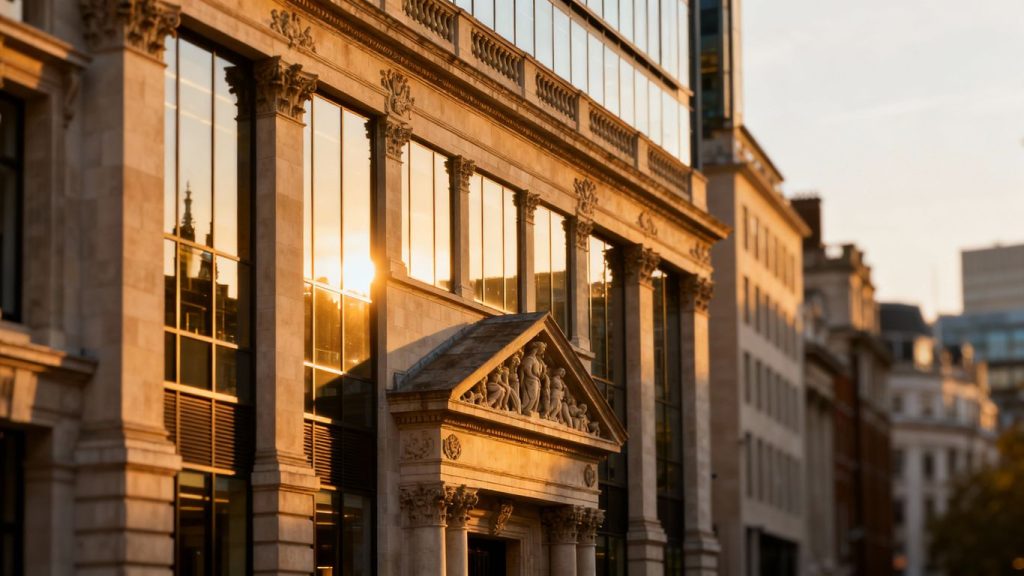
So, you’ve probably heard about the Financial Times Stock Exchange index, or maybe just “the Footsie” as folks in the know call it. It sounds important, and it is. Think of it as a big snapshot of how the UK’s biggest companies are doing in the stock market. We’re going to break down what this index is all about, where it came from, and why people pay attention to it. It’s not as complicated as it sounds, and understanding it can give you a better idea of what’s happening with the UK economy.
Key Takeaways
- The Financial Times Stock Exchange index, often called the Footsie, tracks the 100 largest companies on the London Stock Exchange by their market value.
- The terms FTSE 100 and Footsie 100 are used interchangeably to refer to the same index.
- This index started in 1984 and is calculated based on the market capitalization of its companies, meaning bigger companies have a larger impact.
- The index is reviewed and updated regularly to make sure it still represents the top 100 companies accurately.
- Many people use the financial times stock exchange index as a way to understand the general health of the UK economy and as a benchmark for investments.
Understanding The Financial Times Stock Exchange Index
What Is The Financial Times Stock Exchange Index?
The Financial Times Stock Exchange index, often shortened to the "Footsie" or "FTSE 100," is a widely recognized measure of the performance of the United Kingdom’s largest publicly traded companies. Think of it as a snapshot of the health of the UK’s biggest businesses. It’s compiled by the FTSE Group, a joint venture between the Financial Times and the London Stock Exchange. The index tracks the 100 companies listed on the London Stock Exchange that have the largest market capitalization. Market capitalization is simply the total value of a company’s shares on the market. So, the bigger the company in terms of its market value, the more influence it has on the Footsie’s movements.
The Footsie And The FTSE 100: An Interchangeable Term
You’ll often hear the terms "Footsie" and "FTSE 100" used interchangeably. They both refer to the same index, which tracks the 100 largest companies listed on the London Stock Exchange based on their market value. The nickname "Footsie" comes from the phonetic pronunciation of "FTSE."
Key Components Of The Index
The FTSE 100 is made up of 100 of the largest companies listed on the London Stock Exchange. These companies are selected based on their market capitalization, which is the total market value of a company’s outstanding shares of stock. The companies that make up the Footsie represent a wide range of industries, including:
- Consumer goods and services
- Finance (banks, insurance)
- Energy (oil and gas)
- Healthcare and pharmaceuticals
- Industrials and engineering
- Telecommunications
This mix means the index’s performance is influenced by trends across many different parts of the economy, not just one or two. The composition of the FTSE 100 is not static; it’s a living index, with companies potentially moving in and out based on their size and performance. This regular review, typically done quarterly, ensures the index remains a relevant measure of the UK’s largest publicly traded businesses.
The Mechanics Of The Financial Times Stock Exchange Index
So, how does this big number, the FTSE 100, actually get calculated? It’s not just a simple average of stock prices. There’s a bit more to it, and understanding these mechanics helps explain why the index moves the way it does.
Market Capitalization-Weighted Methodology
The FTSE 100 uses a method called market capitalization weighting. This means that companies with a larger market value have a bigger say in the index’s overall performance. Think of it like this: if a giant company like Shell or AstraZeneca makes a big move, it’s going to pull the FTSE 100 more than a smaller company in the index. Market capitalization is calculated by multiplying the company’s current share price by the total number of its outstanding shares. So, the bigger the company’s total market value, the more weight it carries within the index.
Regular Rebalancing And Index Updates
The stock market isn’t static, and neither is the FTSE 100. To keep the index relevant and reflective of the current economic landscape, its components are reviewed regularly. This process, typically done quarterly, involves checking if companies still meet the criteria for inclusion. Companies that have grown significantly might move up, while others that have shrunk or been acquired might be removed. This ensures the index continues to represent the 100 largest companies on the London Stock Exchange accurately.
The Role Of The Index Divisor
Another key part of the calculation is the index divisor. This is a number used to adjust the total market capitalization of the companies in the index. Why is it needed? Well, it helps to smooth out the impact of things like stock splits, share buybacks, or the addition or removal of companies. Without the divisor, these corporate actions could cause artificial jumps or drops in the index, making it harder to track genuine market movements. The divisor ensures that the index value remains consistent and comparable over time, even when the underlying components or their share structures change.
The FTSE 100 is designed to be a dynamic representation of the UK’s largest listed companies. Its calculation method, which gives more influence to bigger companies and is regularly updated, means it’s a constantly evolving snapshot of the market.
The Significance Of The Financial Times Stock Exchange Index In Trading
Benchmark For Investment Performance
The FTSE 100, or "Footsie" as it’s often called, is a go-to reference point for checking how investments are doing. Think of it like a standard ruler for measuring success in the UK stock market. Fund managers and individual investors frequently compare their own portfolio returns against the Footsie’s performance. If a fund is supposed to represent the UK market, its results are often stacked up against this index. Did it do better, worse, or about the same? This comparison helps people figure out if their investment strategy is working or if the person managing their money is doing a good job. It’s a straightforward way to see if your returns are keeping pace with the broader market.
Tools For Asset Allocation
When people talk about asset allocation, they mean deciding how to split their money among different types of investments, like stocks, bonds, or property. The FTSE 100 represents a big chunk of the UK’s stock market, so it plays a role here. An investor might decide to put a certain amount of their money into UK stocks, and the Footsie can act as a stand-in for that part of their portfolio. For example, someone could invest in an exchange-traded fund (ETF) that follows the FTSE 100. This gives them exposure to all 100 companies at once, making it simpler to spread their investments across the UK market. It also helps in understanding how different economic events might affect a portion of their holdings.
Underlying For Derivative Products
The FTSE 100 isn’t just for direct investment; it’s also the basis for many financial products called derivatives. These include things like futures and options contracts. Essentially, these contracts allow traders to make bets on whether the FTSE 100 will go up or down in the future, without actually owning all the shares in the index. This can create opportunities for profit, but it also comes with a higher level of risk because you’re dealing with potential future price movements. These products are used by various market participants for different reasons, from hedging existing positions to pure speculation on market direction.
The FTSE 100 serves as a vital indicator, offering a clear view of the UK’s largest companies and their collective performance. Its influence extends beyond simple tracking, impacting investment strategies and the creation of complex financial instruments.
Historical Performance And Milestones
Early Growth and the Dot-Com Era
The Financial Times Stock Exchange 100 Index, or FTSE 100, officially kicked off on January 3, 1984, with a starting value of 1000. In its early years, the index saw steady growth, reflecting the expansion of the UK economy. The 1990s brought a significant surge, particularly towards the end of the decade. This period was heavily influenced by the dot-com boom, a time of rapid investment and speculation in internet-based companies. By 1995, the FTSE 100 had already crossed the 3,000-point mark. The excitement peaked on the last trading day of 1999, when the index reached an all-time high of 6,950.6 points. This era showed how new technologies and investor enthusiasm could dramatically impact market performance.
Navigating Economic Crises
Like any market indicator, the FTSE 100 hasn’t always trended upwards. The early 2000s brought the bursting of the dot-com bubble, leading to a significant market correction. More challenging times arrived with the global financial crisis of 2008-2009. During this period, the index experienced a sharp decline as economic instability spread worldwide. The subsequent years saw periods of recovery, but also new uncertainties. The European sovereign debt crisis and, more recently, the UK’s vote to leave the European Union (Brexit) introduced further volatility. These events demonstrate the index’s sensitivity to major global economic and political developments.
Recent Performance Trends
In the years following the 2008 financial crisis, the FTSE 100 has shown resilience, though its path has been uneven. The index’s performance continues to be influenced by global economic conditions, commodity prices (given the significant weighting of energy and mining companies), and geopolitical events. For instance, fluctuations in oil prices can have a noticeable effect on the index’s overall movement. Similarly, shifts in international trade policies or economic growth in major global economies can impact the performance of the UK’s largest listed companies. While specific point values can be misleading due to different base values used at launch, the percentage change over time provides a clearer picture of its performance trajectory. The FTSE 100 remains a key indicator of the health of the UK’s largest businesses and their standing in the global marketplace.
The FTSE 100’s history is a reflection of broader economic cycles, technological shifts, and global events. Its journey from its inception in 1984 to its current standing illustrates the dynamic nature of financial markets and the adaptability of the companies it represents.
Broader FTSE Indices And Market Representation

While the FTSE 100 often gets the most attention as the UK’s main stock market indicator, it’s really just one part of a larger picture. The FTSE Group actually manages a whole collection of indices, each giving a different view of the market. Understanding these other indices helps us get a fuller sense of the UK’s economic situation and investment possibilities.
The FTSE 250 And Mid-Cap Companies
Think of the FTSE 250 as the next group of companies after the top 100. This index tracks the performance of the 250 companies that come after the FTSE 100 in terms of their market value on the London Stock Exchange. These are often called mid-cap companies. They might not have the worldwide reach of the biggest companies in the FTSE 100, but they can be quite active and offer a different investment angle. Sometimes, companies in the FTSE 250 are seen as having more room to grow because they are past the early stages of small-cap companies but aren’t as established as the very large ones.
The Comprehensive FTSE All-Share Index
If you want a really wide view of the market, the FTSE All-Share Index is the one to look at. This index includes a much larger number of companies – usually over 900 – from the London Stock Exchange. It’s basically a combination of the FTSE 100, FTSE 250, and the FTSE SmallCap indices. The FTSE All-Share is often considered the most accurate reflection of the entire UK stock market. Because it covers so many different companies of various sizes and in different industries, it gives a more complete measure of how the market is doing compared to just looking at the biggest companies.
Other Notable FTSE Benchmarks
Beyond the FTSE 100, 250, and All-Share, there are other indices that serve specific purposes. For example, the FTSE SmallCap Index focuses on smaller companies listed on the LSE, showing how emerging businesses are performing. There are also indices for specific industries and indices that track companies listed on the Alternative Investment Market (AIM), like the FTSE AIM UK 50 and FTSE AIM 100, which are aimed at smaller, growing companies.
These different FTSE indices work together, much like different camera lenses, allowing investors and analysts to focus on specific parts of the market or get a broad overview of the entire UK stock exchange. Each index provides a unique piece of information, adding to a better understanding of market trends and economic health.
It’s important to note that while the FTSE 100 is a significant indicator, it’s heavily influenced by companies with large international operations. This means its performance doesn’t always directly mirror the health of the UK’s domestic economy. For a view more focused on UK-based businesses, the FTSE 250 might offer a different perspective, as its constituent companies tend to have less overseas revenue compared to those in the FTSE 100.
Strategies For Engaging With The Financial Times Stock Exchange Index

So, you’ve got a handle on what the FTSE 100 is and how it’s put together. Now, how do you actually get involved with it? There are a few common ways people interact with this major index, each with its own approach and potential benefits. The best strategy really depends on your personal financial goals, how much risk you’re comfortable with, and how much time you want to spend managing your investments.
Investing Through Index Funds And ETFs
One of the most straightforward ways to get exposure to the FTSE 100 is by investing in index funds or Exchange Traded Funds (ETFs) that track its performance. Think of these funds as a basket holding all the stocks that make up the index, in the same proportions. When you buy a share of the fund, you’re essentially buying a tiny piece of all those 100 companies. This approach offers instant diversification, meaning your investment isn’t tied to the fortunes of just one or two companies. It’s a simple way to mirror the performance of the UK’s largest businesses without having to pick individual stocks yourself.
- Diversification: Spreads risk across 100 companies.
- Low Cost: Index funds and ETFs typically have lower management fees than actively managed funds.
- Simplicity: Easy to buy and sell, similar to individual stocks.
- Transparency: You know exactly what you’re invested in, as it tracks a specific index.
Direct Stock Ownership
For those who want a more hands-on approach, direct stock ownership is an option. This involves buying shares in individual companies that are part of the FTSE 100. While this can potentially lead to higher returns if you pick the right companies, it also comes with increased risk and requires more research. You’ll need to stay on top of company news, financial reports, and industry trends for each stock you own. It’s a way to build a portfolio tailored precisely to your preferences, but it demands more attention and a deeper understanding of individual businesses.
Utilizing Futures And Options
More sophisticated investors might look at derivatives like futures and options contracts. These financial products are based on the future price of the FTSE 100 index. Traders use them to speculate on whether the index will go up or down, or to hedge their existing investments. For example, you could buy a futures contract if you believe the FTSE 100 is heading higher. These instruments can offer significant leverage, meaning a small price movement can result in a large profit or loss. Because of their complexity and the potential for substantial risk, futures and options are generally best suited for experienced traders who fully understand the mechanics and potential downsides.
Engaging with the FTSE 100 can take many forms, from broad, diversified index funds to direct stock ownership or complex derivatives. The best strategy depends entirely on your personal financial goals, your comfort level with risk, and the amount of time you’re willing to dedicate to managing your investments.
Wrapping Up Our Look at the FTSE 100
So, we’ve walked through what the FTSE 100, or ‘Footsie’ as it’s often called, really is. It’s basically a snapshot of the UK’s biggest companies, giving us a good idea of how the economy is doing. We saw how it started back in 1984 and how it’s changed over the years, reflecting all sorts of economic ups and downs. Whether you’re a seasoned investor or just curious, understanding this index is pretty helpful for getting a feel for the market. It’s not just about numbers; it’s a story of business and the economy. Keep this knowledge handy as you explore the world of investing.
Frequently Asked Questions
What exactly is the Financial Times Stock Exchange Index?
Think of the Financial Times Stock Exchange Index, often called the “Footsie” or FTSE 100, as a list of the 100 biggest companies traded on the London Stock Exchange. It’s like a snapshot showing how these major companies are doing, which helps us understand the health of the UK’s economy.
Is ‘Footsie’ the same as the FTSE 100?
Yes, they are the same thing! ‘Footsie’ is just a friendly nickname for the FTSE 100 index. People started calling it that because ‘FTSE’ sounds like ‘footsie’ when you say it out loud.
How does the FTSE 100 decide which companies are included?
The index includes the 100 companies listed on the London Stock Exchange that have the biggest market value. Market value is the total worth of all a company’s shares. So, bigger companies have a bigger say in how the index moves.
Why is the FTSE 100 important for investors?
It’s important because it acts as a benchmark, like a measuring stick. Investors use it to see how well their own investments are performing compared to the UK’s biggest companies. It also helps them decide where to put their money.
Does the FTSE 100 always include the same companies?
No, the list of companies can change. The index is checked regularly, usually every three months. If a company’s value drops or another company’s value rises a lot, they might be swapped in or out to keep the index accurate.
What are some other FTSE indices besides the FTSE 100?
Besides the FTSE 100, there’s the FTSE 250, which tracks the next 250 biggest companies (mid-sized ones). There’s also the FTSE All-Share Index, which includes over 900 companies for a really broad view of the UK market.

Peyman Khosravani is a global blockchain and digital transformation expert with a passion for marketing, futuristic ideas, analytics insights, startup businesses, and effective communications. He has extensive experience in blockchain and DeFi projects and is committed to using technology to bring justice and fairness to society and promote freedom. Peyman has worked with international organizations to improve digital transformation strategies and data-gathering strategies that help identify customer touchpoints and sources of data that tell the story of what is happening. With his expertise in blockchain, digital transformation, marketing, analytics insights, startup businesses, and effective communications, Peyman is dedicated to helping businesses succeed in the digital age. He believes that technology can be used as a tool for positive change in the world.