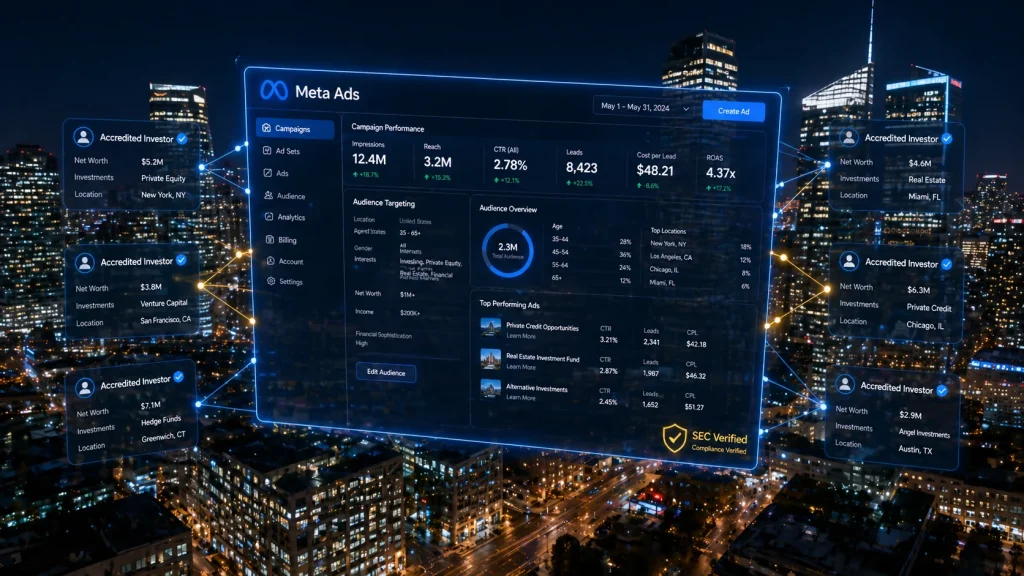
Reaching accredited investors is one of the most targeted and compliance-sensitive challenges in financial marketing. Traditional outreach through conferences, cold email, and broker networks is expensive and slow. A growing number of fintech startups are discovering that a specialist meta ads agency can deliver faster, more measurable access to the exact investor audience they need.
There are complexities associated with the process. Advertisers will have to work within a very narrow boundary in the case of advertising finance-related products via Meta platforms due to policy limitations and SEC regulations, among other challenges.
Why Meta Ads Work for Fintech Investor Targeting
Meta’s advertising platform offers fintech startups access to one of the most sophisticated behavioral targeting systems available, making it possible to reach high-net-worth individuals and accredited investors at a fraction of the cost of traditional financial marketing channels.
Most fintech founders underestimate how precisely Meta’s audience system can identify potential accredited investors. The platform does not allow direct income or net worth targeting, but it does allow targeting based on:
- Professional titles such as CFO, Managing Director, and Partner at financial firms
- Interests include alternative investments, angel investing, and venture capital
- Behavioral signals tied to premium financial product engagement
- Lookalike audiences built from existing accredited investor lists
A skilled paid social agency knows how to layer these signals to build audiences that skew heavily toward individuals who meet the accredited investor threshold without violating Meta’s financial advertising policies.
The Compliance Layer Most Fintech Startups Miss
Meta Advertising rules for fintech startups looking to acquire investments through their platform, and also the SEC Regulation D guidelines must be complied with at the same time. Failure to adhere to either means the risk of having the account suspended
This is where most fintech founders make costly mistakes. Meta requires financial advertisers to submit to a pre-authorization process before running certain categories of investment-related ads. The requirements include:
- Proof of business registration and financial licenses, where applicable
- Disclosure language meeting Meta’s financial product ad standards
- Compliance with country-specific regulations for financial promotions
- Landing page requirements that match the claims made in the ad creative
At the same time, SEC Regulation D Rule 506(c) governs how startups can publicly solicit accredited investors. According to the SEC’s guidelines on general solicitation and advertising, companies relying on this exemption must take reasonable steps to verify accredited investor status and ensure all advertising materials are accurate and not misleading.
A qualified financial advertising specialist who works with fintech clients understands both layers and builds campaigns that satisfy both sets of requirements from the start.
What Sets a Fintech-Focused Agency Apart
The specialist firm dealing in the area of fintech investor acquisitions designs its campaigns based on a creative approach driven by compliance, precise audience segmentation, and lead generation landing pages.
General advertising agencies approach Meta campaigns with a conversion-first mindset. Fintech investor campaigns require a different framework, which is exactly why founders increasingly turn to a dedicated meta ads agency rather than a generalist shop.
Here is what a fintech-focused agency does that most general agencies do not:
- Focuses on building ad copy that incorporates elements of trust rather than urgency, seeing that accredited investors value credibility more than urgency
- Structures campaigns to generate qualified leads rather than raw volume, since unqualified investor leads create compliance risk downstream
- Constructs ads that produce leads that are qualified and not simply those that result from a number of people being directed to the site
- Designs landing pages that pre-qualify visitors through income and investment experience questions before collecting contact information
- Analyzes campaign performance based on cost per qualified lead instead of cost per click
As hedgethink.com has noted, scalable advertising infrastructure matters for business growth precisely because the systems behind a campaign determine whether it can grow without breaking down under volume or compliance pressure.
The Creative Strategy That Converts Accredited Investors
The accredited investor audience on Meta is responsive to content that showcases expertise, honesty regarding risk, and social proof. On the other hand, creative that depends on generic finance promises and copywriting tactics do not succeed at all.
Fintech startups often bring consumer brand creative instincts to investor acquisition campaigns. The two audiences require fundamentally different approaches.
Creative that works for accredited investor campaigns typically includes:
- Founder-led video content explaining the investment thesis in plain language
- Data-driven performance claims backed by verifiable track records
- Third-party validation, such as press coverage, awards, or institutional partnerships
- Transparent risk disclosures are presented as a sign of credibility rather than a legal obligation
- Social proof from existing investors, including fund managers or known angels
Low-performing creative includes the use of urgency language such as special time offers, promises of returns without any factual data backing up those claims, and well-polished advertisements that seem detached from the investment itself.
Hedgethink.com has also highlighted that effective online ad campaigns for sophisticated audiences depend on message-market fit more than creative production quality. This is especially true in fintech investor acquisition, where the audience has a high tolerance for substance and a low tolerance for hype.
The Five Questions Fintech Founders Are Not Asking Before Hiring an Agency
The five questions that separate a genuinely qualified fintech advertising agency from a general paid social shop cover Meta financial authorization, SEC Regulation D experience, cost per qualified lead benchmarks, in-house compliance review processes, and how the agency defines an accredited investor lead.
Before hiring any agency for investor acquisition work, fintech founders should ask:
- Has the agency obtained Meta financial services advertising authorization for prior clients?
- Do they have documented experience running campaigns under SEC Regulation D Rule 506(c)?
- Can they show verified cost per qualified lead benchmarks from previous fintech campaigns?
- Do they have an in-house compliance review process for ad creative and landing page copy?
- How do they define a qualified lead in the context of accredited investor campaigns?
Agencies that cannot answer these questions confidently are not equipped for fintech investor acquisition work, regardless of their general performance record.
Frequently Asked Questions
Can fintech startups legally advertise to accredited investors on Meta?
Yes, the fintech startups issuing securities under Regulation D Rule 506c are allowed to use public advertisements for investments, but they need to make sure that those investors interested in the deal are indeed accredited, and their advertisements should be factual and truthful. This can be done by an ad agency that specializes in financial ads that will fit Meta’s policies as well as SEC regulations.
What makes accredited investor targeting on Meta different from regular audience targeting?
Meta does not permit direct targeting based on income or net worth for financial products. The best way to target an audience that resembles the accredited investor is through the use of professional titles, financial interest groups, and behaviors in order to layer the audiences that represent the accredited investor. This is done by a specialized agency that understands how to do it without mistakes.
How much does it cost to run Meta ads for fintech investor acquisition?
The cost per lead for accredited investors’ advertising campaigns is significantly higher when compared to that of other marketing campaigns due to the low number of people who can qualify for such a marketing campaign. A budget of less than $5,000 per month for any marketing campaign is not enough to collect sufficient data. Fintech companies usually invest between $10,000 and $30,000 per month.
What compliance risks should fintech startups know about before running Meta investor ads?
The two primary compliance risks are Meta account suspension for violating financial services advertising policies and SEC enforcement action for advertising materials that make misleading claims or fail to verify accredited investor status. Working with an agency that understands both risk layers and builds campaigns with pre-authorization, proper disclosures, and verified investor qualification processes reduces both risks significantly.
How long does it take to see results from a Meta Ads campaign targeting accredited investors?
Most fintech investor acquisition campaigns require four to eight weeks of active optimization before generating reliable cost per qualified lead data. The first two weeks typically involve audience testing, the next two involve creative iteration, and the following month involves scaling what is working. A specialist meta ads agency with prior fintech experience can compress this timeline using benchmarks from previous campaigns.
Conclusion
Reaching accredited investors through paid social is no longer a speculative strategy for fintech startups. It is a proven acquisition channel when executed by an agency that understands both the platform mechanics and the compliance requirements unique to financial advertising.
The fintech startups that are experiencing success aren’t the companies spending the most money on advertising. These are the startups that have an advertising partner who views compliance as the bedrock of their business, crafts content that appeals to the psychology of investors, and defines success by lead generation, not impressions.
When it comes to investor acquisition in 2026, the question isn’t whether or not Meta ads will work for your fintech startup. The real question is whether or not you’re hiring an agency that knows what it’s doing.

Peyman Khosravani is a global blockchain and digital transformation expert with a passion for marketing, futuristic ideas, analytics insights, startup businesses, and effective communications. He has extensive experience in blockchain and DeFi projects and is committed to using technology to bring justice and fairness to society and promote freedom. Peyman has worked with international organizations to improve digital transformation strategies and data-gathering strategies that help identify customer touchpoints and sources of data that tell the story of what is happening. With his expertise in blockchain, digital transformation, marketing, analytics insights, startup businesses, and effective communications, Peyman is dedicated to helping businesses succeed in the digital age. He believes that technology can be used as a tool for positive change in the world.