Trying to figure out where the financial markets are going can feel like a puzzle. Especially when you’re looking at things like financial times stocks, it’s easy to get lost in all the numbers and news. This guide is here to help make sense of it all. We’ll break down how to spot trends, understand what’s moving stock prices, and use information from sources like the Financial Times to make smarter choices. It’s not about magic tricks, but about having a clearer picture.
Key Takeaways
- Keep an eye on what’s happening in the market right now and what economic signs might affect financial times stocks.
- Learn how to read stock charts and patterns to get a better idea of where prices might go.
- Pay attention to how people are feeling about the market, as this can influence stock movements.
- Always have a plan for managing risks, like knowing when to sell or spread your investments around.
- The world of finance changes, so keep learning new things about financial times stocks and market changes.
Understanding Financial Times Stocks Market Trends
Keeping up with the financial markets can feel like trying to catch a train that’s already moving. It’s easy to feel lost if you’re not paying attention to the bigger picture. This section is all about getting a handle on what’s happening right now and why it matters for stocks featured in the Financial Times.
Identifying Current Market Movements
Spotting trends early is key. Think about it: if you can see where things are heading before everyone else, you’re in a better position. We’re not talking about crystal balls here, but rather a systematic way of observing what’s going on. This involves looking at how different sectors are performing, which companies are making headlines, and what the general mood of investors seems to be. For instance, if technology stocks have been on a tear for months, that’s a trend. But is it continuing, slowing down, or reversing? Paying attention to these shifts helps you understand the current landscape.
- Observe sector performance: Are tech stocks still leading, or are financials taking over?
- Track company news: Major announcements from large companies can ripple through the market.
- Gauge investor sentiment: Are people feeling optimistic or cautious about the future?
The market doesn’t always move in straight lines. Sometimes, a strong upward trend can pause or even dip temporarily before continuing. Understanding these nuances is part of identifying the real movement versus just noise.
Economic Indicators Influencing Stock Performance
Beyond company-specific news, the broader economy plays a huge role. Think of economic indicators as the vital signs of a country’s financial health. Things like interest rates, inflation figures, and job growth numbers all send signals about how the economy is doing, which directly impacts how stocks perform. For example, if the central bank raises interest rates, borrowing becomes more expensive, which can slow down business growth and make investors a bit more hesitant about stocks. Conversely, strong job growth often means people have more money to spend, which is generally good for companies. Keeping an eye on these indicators, like those reported by the Financial Times, gives you context for market swings.
Here’s a look at some key indicators:
| Indicator | What it Measures |
|---|---|
| Interest Rates | Cost of borrowing money |
| Inflation (CPI) | Rate at which prices for goods and services rise |
| GDP Growth | Overall economic output |
| Unemployment Rate | Percentage of the labor force without jobs |
Leveraging Financial Times Insights
The Financial Times itself is a treasure trove of information. It’s not just about the stock prices; it’s about the analysis and reporting that explain why those prices are moving. Reading articles about economic policy, global trade developments, or industry-specific challenges can provide a deeper understanding. For example, a report detailing supply chain issues for small fashion brands can help you anticipate potential impacts on related companies. The publication often features expert opinions and data that can help you connect the dots between global events and stock market behavior. Staying informed through reliable sources like the FT is a smart move for any investor looking to understand market trends.
Mastering Technical Analysis for Financial Times Stocks
Technical analysis is a method used to evaluate investments and identify trading opportunities by analyzing statistical trends gathered from trading activity, such as price movement and volume. It’s about looking at the past to understand potential future movements. This approach helps traders make more informed decisions by looking at historical data rather than company fundamentals.
Decoding Chart Patterns
Chart patterns are formations on price charts that can suggest future price movements. Recognizing these patterns can give you an edge. Some common patterns include:
- Head and Shoulders: Often seen as a reversal pattern, indicating a potential shift from an uptrend to a downtrend.
- Triangles (Ascending, Descending, Symmetrical): These can signal a continuation or a reversal of a trend, depending on their formation.
- Flags and Pennants: These are short-term continuation patterns that appear after a sharp price move, suggesting the trend is likely to continue.
Understanding these patterns requires practice and observation. It’s like learning a new language, where each pattern tells a story about market sentiment and potential direction.
Utilizing Candlestick and Bar Charts
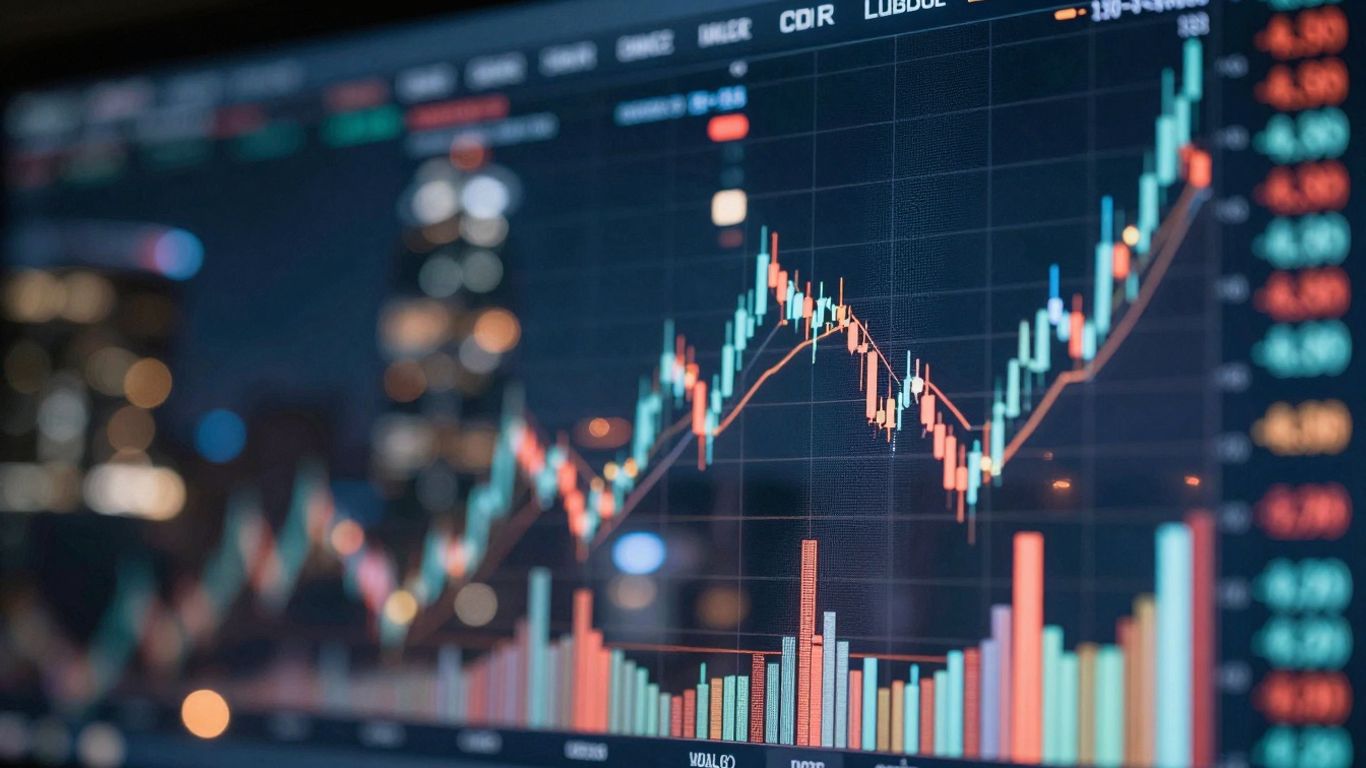
Candlestick charts and bar charts are visual tools that display the price of a security over a specific period. Each ‘bar’ or ‘candlestick’ typically shows the open, high, low, and closing prices for that period.
- Candlestick Charts: These are popular for their visual representation of price action. The color of the ‘body’ of the candlestick (usually green/white for up, red/black for down) quickly shows whether the price increased or decreased during the period. The ‘wicks’ or ‘shadows’ show the high and low.
- Bar Charts (OHLC Charts): Similar to candlesticks, bar charts show the open, high, low, and close. They use horizontal lines to indicate the open and close prices, with a vertical line showing the range.
These charts provide a lot of information in a compact format, allowing traders to quickly assess price volatility and direction. You can test different approaches using a demo trading app that provides real market data.
Predicting Future Price Movements
While technical analysis doesn’t predict the future with certainty, it aims to identify probabilities. By combining chart patterns, indicators, and an understanding of market psychology, traders try to forecast where prices might go.
Technical analysis relies on the idea that market prices reflect all available information and that prices move in trends. It’s a discipline that requires continuous learning and adaptation as market conditions change.
Tools like moving averages, Relative Strength Index (RSI), and MACD can be used alongside chart patterns to confirm signals. For instance, if a bullish chart pattern appears and a momentum indicator like RSI is also showing positive signs, it strengthens the case for a potential price increase. It’s about building a case based on multiple pieces of evidence from the charts. Remember, no single indicator or pattern is foolproof, and combining different methods often leads to better results.
Sentiment Analysis in Financial Times Stocks
Understanding the mood of the market is a big part of trading, and sentiment analysis helps us do just that. It’s about figuring out if investors are feeling optimistic or pessimistic, and how that might affect stock prices. Think of it like reading the room before making a big decision.
Gauging Market Mood from News and Social Media
News headlines and what people are saying on social media can give us clues about how traders are feeling. A lot of positive news about a company or industry might make people more likely to buy, while negative stories can lead to selling. It’s not just about the facts, but how those facts are presented and received. For example, a report from the Financial Times about strong earnings might be overshadowed by a commentator’s negative outlook, influencing trader behavior.
Tools for Real-Time Sentiment Monitoring
There are tools out there that can help track this market mood. Platforms like StocksToTrade can scan news and social media to give you a sense of the general feeling towards specific stocks or the market as a whole. These tools can process a huge amount of information quickly, showing you trends in sentiment that might be hard to spot otherwise. Keeping an eye on these real-time updates can be quite helpful.
Integrating Sentiment into Trading Strategies
So, how do you actually use this information? You can add sentiment analysis to your existing trading plan. If you see a stock getting a lot of positive buzz and the news is good, it might confirm a decision to buy. Conversely, if sentiment turns negative, it could be a signal to be cautious or even consider selling. It’s about using this extra layer of information to make more informed choices, rather than just relying on charts alone.
Sentiment analysis isn’t a crystal ball, but it adds a valuable dimension to understanding market movements. It helps explain why prices might move even when the hard financial data doesn’t seem to justify it.
Here’s a simple way to think about it:
- Positive Sentiment: Often associated with rising stock prices. This can be fueled by good company news, positive economic outlooks, or general investor optimism.
- Negative Sentiment: Can lead to falling stock prices. This might be triggered by bad news, economic downturns, or widespread investor fear.
- Neutral Sentiment: The market is steady, with no strong prevailing mood. This often happens when there’s a balance of good and bad news, or simply a lack of significant market-moving events.
Effective Risk Management for Financial Times Stocks
Managing risk is a key part of investing in Financial Times stocks, or any stocks for that matter. It’s not about avoiding losses entirely, which is impossible, but about controlling them so they don’t derail your financial goals. Think of it like driving a car; you wear a seatbelt and follow traffic laws not to prevent accidents, but to minimize harm if one occurs.
Setting Profit and Loss Targets
Before you even buy a stock, it’s smart to decide what you’d consider a good profit and what level of loss would make you sell. This helps take emotion out of the decision when the market is moving fast. For example, you might set a target to sell a stock if it goes up by 15%, locking in that gain. On the flip side, you might decide to sell if it drops by 10% to stop further losses. These are often called ‘take-profit’ and ‘stop-loss’ orders.
- Take-Profit Orders: These automatically sell your stock when it reaches a predetermined higher price, securing your gains.
- Stop-Loss Orders: These automatically sell your stock when it falls to a specific lower price, limiting your potential downside.
- Trailing Stop-Loss Orders: A more advanced type that moves up with the stock price, but stays put if the price falls, offering protection while allowing for continued gains.
Deciding on these targets beforehand helps you stick to a plan, preventing impulsive decisions driven by fear or greed when market conditions change rapidly.
The Importance of Portfolio Diversification
Putting all your money into one or two stocks is like putting all your eggs in one basket. If that basket drops, you lose everything. Diversification means spreading your investments across different types of assets, industries, and even geographic regions. The idea is that when one part of your portfolio is doing poorly, another part might be doing well, balancing things out.
For instance, in 2025, we saw international stocks perform very strongly, sometimes even better than U.S. stocks. Having exposure to both can smooth out your overall returns. Similarly, mixing stocks with bonds can help cushion the blow during stock market downturns, as bonds often behave differently.
- Across Asset Classes: Holding stocks, bonds, real estate, and perhaps commodities.
- Within Asset Classes: Owning stocks from different sectors (like technology, healthcare, energy) and different company sizes (large-cap, small-cap).
- Geographically: Investing in companies based in different countries or regions.
Utilizing Hedging Techniques
Hedging is a more advanced strategy used to offset potential losses in an investment. It’s like buying insurance for your portfolio. While it can reduce risk, it often comes at a cost and can also limit your potential gains if the market moves in your favor.
One common way to hedge is by using options contracts. For example, if you own a stock and are worried it might fall, you could buy a ‘put option’. This gives you the right, but not the obligation, to sell that stock at a specific price before a certain date. If the stock price drops significantly, the value of your put option increases, helping to offset the loss on the stock itself. Another approach involves investing in assets that tend to move in the opposite direction of your main holdings, such as certain inverse ETFs or commodities that perform well when stocks are struggling.
Continuous Learning in Financial Times Stocks

The financial markets are always changing. What worked last year might not work today. Staying informed is not just a good idea; it’s a requirement if you want to keep up with Financial Times stocks and market trends. This means making a habit of learning new things and updating your knowledge regularly.
Adapting to Evolving Market Dynamics
Markets shift due to many things: new technologies, global events, and changes in how companies operate. For instance, the rise of artificial intelligence has created new investment opportunities but also new risks. Understanding these shifts helps you adjust your investment approach. It’s about recognizing when a trend is changing and being ready to act. The ability to adapt is more important than ever in today’s fast-paced financial world. Keeping an eye on how different sectors are performing and why can give you a heads-up on broader market movements. For example, if tech companies start reporting slower growth, it might signal a wider economic slowdown.
Engaging with Industry Publications
Reading regularly from reliable sources is key. Publications like the Financial Times itself, along with others that focus on finance and economics, provide daily updates and in-depth analysis. These articles often discuss economic indicators that influence stock performance, like inflation rates or employment figures. They also highlight companies making significant moves or facing challenges. Think of these publications as your regular check-ins on the health of the market. They can help you spot emerging trends and understand the forces behind them. Staying current with these reports is a practical way to improve your market awareness. You can find detailed market analysis and economic outlooks from sources like McKinsey & Company.
Expanding Knowledge Through Workshops
Beyond reading, actively participating in learning opportunities can make a big difference. Workshops, webinars, and seminars focused on investing and market analysis offer structured ways to gain new skills. These events often feature experts who can explain complex topics in simpler terms and share practical strategies. You might learn about new analytical tools or different ways to assess a company’s financial health. These sessions are also great for networking with other investors and learning from their experiences. It’s a chance to ask questions and get direct feedback. Learning to identify market trends and recognize overextended conditions is a common topic in these educational settings.
The financial world doesn’t stand still. What seems like a solid strategy today might need tweaking tomorrow. Continuous learning isn’t about memorizing facts; it’s about building a flexible mindset that can process new information and adjust course when needed. This ongoing education helps you make more informed decisions and reduces the chances of being caught off guard by unexpected market events.
Navigating Valuations in Financial Times Stocks
When looking at Financial Times stocks, understanding their valuation is key. It’s about figuring out what a company is actually worth, not just what its stock price is saying on any given day. Think of it like buying a house; you wouldn’t just pay the asking price without checking out the neighborhood, the condition of the house, and what similar houses are selling for, right? Stocks are similar. We need to look beyond the ticker symbol.
Understanding Cyclically Adjusted Price-to-Earnings Ratios
One common way to get a sense of stock valuations is by looking at price-to-earnings (P/E) ratios. But a simple P/E can be a bit jumpy because earnings can swing a lot from year to year, especially in certain industries. That’s where the cyclically adjusted P/E ratio, often called the CAPE ratio or Shiller P/E, comes in handy. It smooths things out by looking at average earnings over the past ten years, adjusted for inflation. This gives a more stable picture, helping us see if stocks are generally expensive or cheap compared to their historical performance.
Currently, the CAPE ratio is quite high, nearing levels not seen since the dot-com bubble. This suggests that, on average, investors are paying more for each dollar of a company’s earnings than they have for much of the last century. It’s a signal to pay closer attention.
Sector-Specific Valuation Analysis
It’s not enough to just look at the overall market. Different industries behave differently. For instance, technology companies often trade at higher P/E ratios because investors expect them to grow faster. On the other hand, more established sectors like financials or energy might have lower P/E ratios. Looking at these sector-specific valuations helps you see where the market might be getting a bit too excited or where there could be overlooked opportunities. For example, while tech might be trading at a forward P/E of around 26.8x, energy stocks might be closer to 16x. This difference is significant.
- Technology: High growth expectations often lead to higher P/E ratios.
- Financials: Typically more stable, with valuations reflecting slower, steadier growth.
- Energy: Can be cyclical, with valuations influenced by commodity prices.
- Communication Services: Also tends to trade at higher multiples due to its growth potential.
Distinguishing Fundamentals from Speculation
This is where things get interesting. High valuations aren’t always a bad sign. If a company has strong underlying business fundamentals – like consistent revenue growth, solid profits, and a good management team – then a higher valuation might be justified. However, sometimes stock prices get pushed up by pure speculation, driven by hype rather than actual business performance. The rise of AI has certainly fueled a lot of excitement, with some companies reaching very high valuations based on future potential rather than current results. It’s vital to separate the hype from the reality by digging into a company’s financial reports and understanding its business model.
When market valuations are high, it’s easy to get caught up in the excitement. However, a disciplined approach involves looking beyond the headlines and focusing on the actual financial health and long-term prospects of the companies you’re considering. This careful analysis can help you make more informed investment decisions, whether you’re looking at individual stocks or broader market trends. Remember, even highly-ranked business programs, like those at Imperial College London, emphasize rigorous analysis.
So, when you’re reviewing Financial Times stocks, remember to check the CAPE ratio for a long-term view, compare valuations across different sectors, and always try to understand whether the price is backed by solid business performance or just market enthusiasm.
Wrapping Up Your Market Journey
So, we’ve looked at how to get a handle on what the market’s doing, how to read those charts, and even how to sense the general mood. Remember, knowing this stuff is just the first step. The real trick is putting it all together and managing your money wisely. The financial world changes fast, so keep learning and stay sharp. By sticking with what we’ve discussed, you’ll be better equipped to make smart choices and keep your investments on track.
Frequently Asked Questions
What exactly are market trends, and why are they so important for trading?
Market trends are like the general direction the stock market is moving in. Think of it like a river flowing – sometimes it goes fast, sometimes slow, and sometimes it changes course. Knowing these trends helps traders make smarter choices about when to buy or sell stocks. The Financial Times even says that about 80% of stock movements are tied to these trends!
How can I understand the charts that traders use?
Charts are like a secret code that shows how stock prices have moved over time. Learning to read them, like candlestick or bar charts, is called technical analysis. It’s like learning to read a weather map to predict if it will rain. By looking at patterns on these charts, traders try to guess where the price might go next.
What is ‘sentiment analysis’ and how does it help with trading?
Sentiment analysis is like taking the pulse of the market. It means figuring out if most people are feeling excited (bullish) or worried (bearish) about a stock or the market. You can do this by looking at news headlines, what people are saying on social media, and using special tools. Knowing the general mood can help you make better decisions.
Why is managing risk so important when trading stocks?
Imagine you’re playing a game; you wouldn’t bet your entire allowance on one turn, right? Risk management is similar. It’s about protecting yourself from losing too much money. This means setting limits on how much you’re willing to lose on a trade and not putting all your money into just one type of stock.
How can I keep learning about the stock market?
The stock market is always changing, like a living thing! To be a good trader, you need to keep learning. This means reading articles from places like the Financial Times, maybe taking classes, and talking to other people who trade. The more you learn, the better you’ll get at understanding what’s happening.
What does ‘valuation’ mean when talking about stocks?
Valuation is like figuring out if a stock’s price is fair. It’s like asking if a toy is worth the price tag. Sometimes stocks can seem really expensive, especially if everyone is excited about them (like with AI lately). But it’s important to look at the company’s actual performance and earnings to see if the price makes sense, or if it’s just based on hype.

Peyman Khosravani is a global blockchain and digital transformation expert with a passion for marketing, futuristic ideas, analytics insights, startup businesses, and effective communications. He has extensive experience in blockchain and DeFi projects and is committed to using technology to bring justice and fairness to society and promote freedom. Peyman has worked with international organizations to improve digital transformation strategies and data-gathering strategies that help identify customer touchpoints and sources of data that tell the story of what is happening. With his expertise in blockchain, digital transformation, marketing, analytics insights, startup businesses, and effective communications, Peyman is dedicated to helping businesses succeed in the digital age. He believes that technology can be used as a tool for positive change in the world.