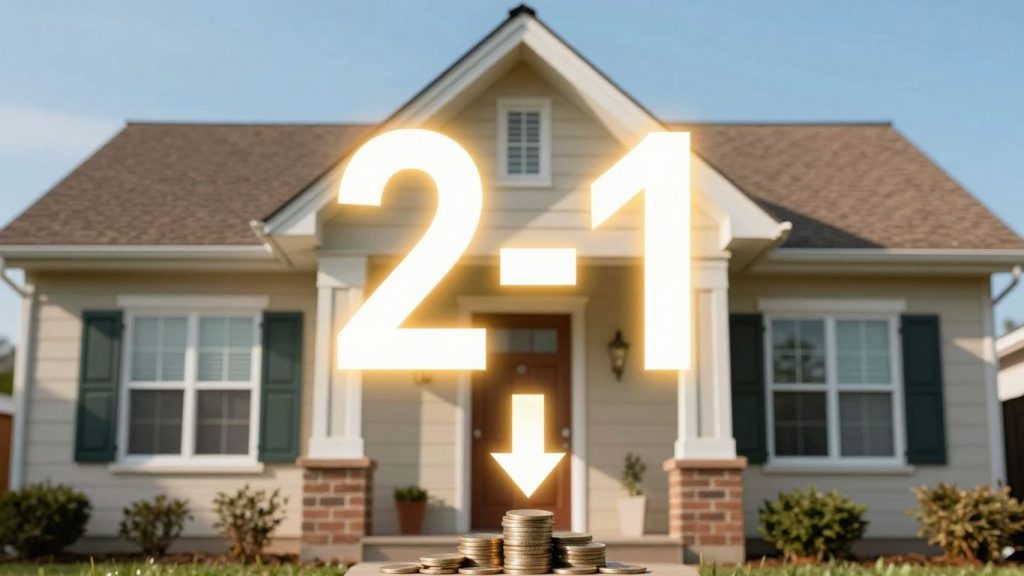
When you’re looking to buy a home, the interest rate on your mortgage is a big deal. Making that rate lower can really change things. If you’re trying to find a way to do just that, you’ve come to the right spot. The 2-1 buydown mortgage might be the practical answer you’re searching for. This guide will break down what a 2-1 buydown is and how it could help you. Let’s get into it.
Key Takeaways
- A 2-1 buydown mortgage lowers your interest rate for the first two years of the loan. Typically, the rate is 2% lower in the first year and 1% lower in the second year.
- This temporary rate reduction results in lower monthly payments initially, making homeownership more accessible early on.
- The cost of the buydown is usually paid upfront, either by the seller, builder, lender, or sometimes by the buyer.
- It’s important to remember that you still need to qualify for the mortgage based on the full interest rate, not the reduced rate.
- While beneficial for managing early cash flow, be prepared for the higher payments that start in the third year when the rate returns to the original level.
Understanding the 2-1 Buydown Mortgage Mechanism
What Constitutes a 2-1 Buydown?
A 2-1 buydown is a type of mortgage arrangement designed to make homeownership more accessible, especially in the initial years of owning a home. Essentially, it’s a way to temporarily lower your interest rate on a fixed-rate mortgage. This isn’t a different type of loan, but rather a feature added to a standard fixed-rate mortgage. Think of it as a special deal for the first couple of years.
Here’s how it typically works:
- Year 1: Your interest rate is reduced by 2 percentage points below the initial rate. For example, if the standard rate is 6%, your rate in the first year would be 4%.
- Year 2: The rate increases by 1 percentage point from the initial rate. In our example, it would go from 4% to 5%.
- Year 3 and beyond: The interest rate adjusts to the original, full rate agreed upon when you took out the mortgage (6% in our example). This rate then remains fixed for the rest of the loan term.
This structure is funded by an upfront payment, often made by the seller or builder, or sometimes by the buyer. This payment essentially subsidizes the lower payments in the first two years, compensating the lender for the reduced interest they receive during that period.
How the Rate Reduction Works Over Time
The core idea behind a 2-1 buydown is to provide a financial cushion during the early stages of homeownership. This temporary reduction in your interest rate directly translates into lower monthly mortgage payments for the first two years. It’s a strategic tool to help borrowers manage their cash flow when they might have other significant expenses associated with moving and setting up a new home, or when they anticipate their income will grow over time.
Let’s look at a hypothetical scenario to see this in action. Imagine a buyer takes out a $300,000 mortgage with a standard interest rate of 6% for 30 years. Without any buydown, their monthly principal and interest payment would be approximately $1,798.65.
With a 2-1 buydown, the payments would look like this:
| Year | Interest Rate | Monthly P&I Payment |
|---|---|---|
| Year 1 | 4.0% | $1,432.25 |
| Year 2 | 5.0% | $1,610.46 |
| Year 3+ | 6.0% | $1,798.65 |
As you can see, the savings in the first two years can be quite substantial, offering immediate relief on your housing costs. This difference is made possible by an upfront payment that covers the difference between the reduced rate payments and what the lender would have received at the full rate.
The upfront cost for the buydown is paid at closing. This payment is held by the lender and used to cover the difference in payments each month for the first two years. It’s a way to smooth out your payment schedule.
The Role of Upfront Payments
The reduced interest rates in the first two years of a 2-1 buydown don’t just happen magically. They are made possible by an upfront payment made at the time of closing. This payment is essentially a lump sum that is used to subsidize the borrower’s monthly payments during the period of the rate reduction. The amount of this upfront payment depends on the loan amount, the difference in interest rates, and the length of the buydown period.
This upfront cost can be funded in a few ways:
- Seller or Builder Contribution: Often, the seller or home builder will pay for the buydown as an incentive to sell their property more quickly, especially in a slower market.
- Lender Incentive: In some cases, a lender might offer a buydown as part of their financing package, though this is less common than seller contributions.
- Buyer Paid: The homebuyer can also choose to pay for the buydown themselves if they believe the long-term savings and initial cash flow relief are worth the upfront cost.
Regardless of who pays, this upfront sum is crucial. It allows the lender to offer the lower interest rates without taking a loss, and it provides the borrower with the benefit of reduced payments right from the start.
Navigating the Mechanics of a 2-1 Buydown
So, how does this 2-1 buydown thing actually work? It’s not as complicated as it might sound. Think of it as a temporary discount on your mortgage interest rate, designed to make those first couple of years of homeownership a little easier on your wallet.
What Constitutes a 2-1 Buydown?
A 2-1 buydown is a specific type of mortgage arrangement where the interest rate is intentionally lowered for the initial period of the loan. Typically, this means the rate is reduced by 2 percentage points in the first year and by 1 percentage point in the second year, compared to the full, long-term interest rate. After these first two years, the interest rate adjusts to the original, agreed-upon rate for the remainder of the loan term.
How the Rate Reduction Works Over Time
The core idea is a gradual increase in your interest rate. You start with a lower rate, which means a lower monthly payment. Then, in the second year, the rate goes up a bit, and so does your payment. Finally, by the third year, you’re paying the full interest rate that was originally set for the loan. This structured increase is what allows for those initial payment savings.
The Role of Upfront Payments
Someone has to pay for this temporary rate reduction. This cost is usually covered by an upfront payment, often referred to as "points" or a lump sum. This money is used to subsidize the interest payments during those first two years. The upfront payment essentially covers the difference between the reduced interest rate you’re paying and the higher interest rate the lender would normally charge. This payment can come from the buyer, the seller, or even the builder, depending on the agreement.
Illustrative Scenario of a 2-1 Buydown
Let’s look at a concrete example. Imagine you’re buying a home with a mortgage for $300,000 at a standard interest rate of 6%. Without a buydown, your monthly principal and interest payment would be around $1,798.65. With a 2-1 buydown:
- Year 1: Your interest rate drops by 2%, making it 4%. Your monthly payment would be approximately $1,432.25.
- Year 2: Your interest rate increases by 1%, to 5%. Your monthly payment would then be about $1,610.46.
- Years 3-30: Your interest rate returns to the original 6%, and your monthly payment settles at $1,798.65 for the rest of the loan.
Calculating Initial Payment Reductions
The savings in the first two years can be quite significant. In our example:
- Year 1 Savings: You save about $366.40 per month ($1,798.65 – $1,432.25).
- Year 2 Savings: You save about $188.19 per month ($1,798.65 – $1,610.46).
These reductions can free up cash flow during a time when you might be settling into a new home and dealing with other moving-related expenses.
The Transition to the Full Interest Rate
It’s really important to be aware of the transition. When your payment jumps from the reduced rate in year two to the full rate in year three, it’s a noticeable increase. You need to be comfortable with that higher payment amount. This is why it’s often recommended for buyers who anticipate their income will increase over the next few years, or who have a solid financial plan to absorb the change.
Strategic Applications of a 2-1 Buydown
A 2-1 buydown mortgage isn’t just about a lower interest rate for a couple of years; it’s a financial tool that can be strategically used to make homeownership more accessible and manageable, especially in the early stages.
Managing Early Homeownership Cash Flow
For many new homeowners, the initial years can be a period of tight budgets. There are often unexpected expenses that come with a new home, from furniture to minor repairs. A 2-1 buydown directly addresses this by lowering your monthly mortgage payment for the first two years. This provides significant breathing room, allowing you to allocate funds towards other immediate needs or simply build up your savings without the pressure of a higher mortgage payment.
- Reduced initial payments free up cash for moving expenses and furnishings.
- Allows for building an emergency fund before facing the full mortgage amount.
- Provides flexibility to handle unexpected home maintenance costs.
The temporary reduction in your monthly payment can make a substantial difference in your ability to settle into your new home comfortably, without feeling financially strained from day one.
Accommodating Lower Initial Budgets
Sometimes, a buyer might qualify for a mortgage based on their current income, but their desired home’s full payment would stretch their budget too thin. A 2-1 buydown can bridge this gap. It allows buyers to purchase a home that might otherwise be slightly out of reach in terms of monthly affordability, knowing that the payment will gradually increase. This can be particularly helpful if the buyer is purchasing in a competitive market where securing a home quickly is important.
Leveraging Anticipated Future Income Growth
This strategy is especially effective for individuals or families who expect their income to rise in the coming years. This could include recent graduates starting their careers, professionals anticipating promotions, or those expecting bonuses or salary increases. The lower payments in the first two years align with a period of potentially lower initial earnings or while waiting for those anticipated income boosts to materialize. By the time the mortgage payment reaches its full rate, your income may have increased sufficiently to comfortably cover it.
- Ideal for those with clear career progression and expected salary increases.
- Helps bridge the gap between current income and future earning potential.
- Allows for purchasing a home now with confidence in future affordability.
Evaluating the Advantages and Disadvantages

Benefits of Reduced Initial Mortgage Payments
A 2-1 buydown can make a real difference in your budget, especially when you first move in. Think about all the costs that come with a new home – furniture, repairs, maybe even some unexpected expenses. Those lower payments in the first year or two give you some breathing room. It’s like getting a bit of a financial cushion when you need it most. This can be particularly helpful if you’re a first-time homebuyer or if you anticipate other large expenses in the near future.
Enhanced Financial Flexibility in Early Years
Beyond just covering immediate costs, the extra money you save initially can be put to work in other ways. You might choose to pay down other debts, build up your savings, or even invest. This flexibility is a key part of what makes a 2-1 buydown attractive. It’s not just about a lower payment; it’s about having more control over your money during those critical early years of homeownership. This can lead to a more stable financial footing as you settle into your new home.
Potential Impact on Mortgage Qualification
It’s important to understand how a 2-1 buydown affects your ability to get the loan in the first place. Lenders will typically qualify you based on the full interest rate, not the temporarily reduced rate. This means your income and debt-to-income ratio need to be strong enough to handle the higher payments that will come later. While the buydown helps with monthly cash flow, it doesn’t usually help you borrow more money initially. You need to be prepared for the payment increase down the road.
Here’s a look at how the payments change:
| Year | Interest Rate | Monthly Payment (Example) |
|---|---|---|
| Year 1 | Original Rate – 2% | Lower |
| Year 2 | Original Rate – 1% | Medium |
| Year 3 onwards | Original Rate | Higher |
Remember, the lower payments are temporary. You must be comfortable with the payment amount at the full interest rate, as this will be your payment for the majority of the loan term. Planning for this increase is key to avoiding future financial strain.
Who Funds the 2-1 Buydown Arrangement?
When you hear about a 2-1 buydown, a natural question pops up: who actually pays for this temporary rate reduction? It’s not magic, and someone has to cover the difference between the reduced payments and what the full interest rate would generate.
The Role of the Seller or Builder
Often, especially in new construction or in a market where sellers want to make their property stand out, the seller or builder might offer to fund the buydown. Think of it as a sales incentive. They’re essentially paying a portion of your interest for the first two years to make the deal more attractive to you, the buyer. This can help them sell their property faster without necessarily lowering the list price permanently. It’s a way to bridge the affordability gap, particularly when interest rates are higher than buyers might prefer.
Lender-Provided Incentives
Sometimes, lenders might offer a 2-1 buydown as a promotional tool. This is less common than seller or builder contributions but can happen, especially if a lender is looking to attract new business or has specific programs available. It’s always worth asking your lender if this is an option they provide.
Buyer-Paid Buydown Options
It’s also possible for the buyer to pay for the 2-1 buydown themselves. This usually involves paying an upfront lump sum at closing. This sum is calculated based on the total interest savings over the first two years. While less common, a buyer might choose this route if they anticipate a significant income increase soon or if other funding sources aren’t available, and they really want those lower initial payments.
The cost of the buydown is typically covered by an upfront payment, which is then placed in an escrow account and applied monthly to reduce your payments.
Here’s a quick look at who typically pays:
- Sellers/Builders: Common in competitive markets or for new homes.
- Lenders: Sometimes offered as a special promotion.
- Buyers: You can pay for it yourself, though it’s less frequent.
It’s important to remember that if a seller or builder is funding the buydown, it often counts towards seller concessions. There are limits on how much a seller can contribute to your closing costs, and the buydown funds must fit within those limits. For conventional loans, these limits can range from 3% to 9% of the loan amount, depending on your down payment. FHA loans have a limit of up to 6%, while VA loans are more flexible but require concessions to be reasonable.
Key Considerations for Borrowers
Before jumping into a 2-1 buydown, there are a few important things to keep in mind. It’s not just about the lower payments you see for the first couple of years; you’ve got to think about the bigger picture.
Qualifying at the Full Interest Rate
This is a big one. Even though your payments will be lower initially, lenders require you to qualify for the mortgage based on the full, standard interest rate. This means your debt-to-income ratio and creditworthiness must meet the lender’s standards as if you were paying that higher rate from day one. The reduced rate is a benefit applied after you’ve already proven you can handle the full cost.
Understanding Seller Concession Limits
If a seller or builder is funding the buydown, it counts as a seller concession. There are limits on how much a seller can contribute toward your closing costs, and this often includes buydown funds. These limits vary depending on the type of loan:
- Conventional Loans: Typically range from 3% to 9% of the loan amount, depending on your down payment.
- FHA Loans: Allow seller concessions up to 6% of the loan amount.
- VA Loans: Are more flexible, with no strict percentage cap, but the concessions must be considered "reasonable."
It’s important to know these limits so you can plan accordingly and ensure the buydown arrangement fits within them.
Assessing Affordability of Future Payments
Remember, the lower payments are temporary. In year three, your interest rate jumps to the full rate, and your monthly payment will increase significantly. You need to be comfortable with this future payment amount. It’s wise to budget for the higher payment starting from day one. Consider if your income is expected to rise or if you have other financial plans to accommodate this increase. Failing to prepare for this payment shock can lead to financial strain down the road.
Comparing 2-1 Buydowns with Alternatives
2-1 Buydown Versus Adjustable-Rate Mortgages
When you’re looking at ways to manage your mortgage payments, especially in the early years of homeownership, a 2-1 buydown and an Adjustable-Rate Mortgage (ARM) often come up. They both offer a lower initial interest rate compared to a standard fixed-rate mortgage, but they work quite differently. A 2-1 buydown provides a predictable, step-down in your interest rate for the first two years, with the rate dropping by 2% in the first year and 1% in the second year, before settling at the full, fixed rate for the remainder of the loan term. This means your payment increases are planned out from the start.
An ARM, on the other hand, typically offers an even lower initial rate for a set period (like 5, 7, or 10 years), after which the rate adjusts periodically based on market conditions. While an ARM might give you a lower payment for a longer initial stretch, it comes with the uncertainty of future rate hikes. You could end up paying more than you initially planned if interest rates go up.
Here’s a quick look at how they stack up:
| Feature | 2-1 Buydown | Adjustable-Rate Mortgage (ARM) |
|---|---|---|
| Initial Low Rate | Yes, 2% lower year 1, 1% lower year 2 | Yes, often lower than 2-1 buydown |
| Rate After Intro | Fixed at the full note rate | Adjusts periodically based on market |
| Payment Predictability | High (increases are known upfront) | Medium to Low (future payments can change) |
| Risk Level | Low (rate is fixed after initial period) | Higher (risk of rising rates) |
The key difference lies in predictability: a 2-1 buydown offers certainty about your future payments, while an ARM introduces market risk.
Exploring Other Buyer Incentives
Beyond temporary rate buydowns like the 2-1, there are several other ways sellers or builders might help make a home more affordable for buyers. These can include:
- Seller Concessions: This is when the seller agrees to pay a portion of your closing costs. This can be a significant help, reducing the amount of cash you need to bring to the closing table. The amount is usually a percentage of the loan amount and has limits depending on the loan type (e.g., Conventional, FHA, VA).
- Permanent Rate Buydown: Unlike a temporary buydown, this involves paying a lump sum upfront to permanently lower your interest rate for the entire life of the loan. It costs more initially than a 2-1 buydown but provides long-term savings.
- Price Reduction: The most straightforward incentive is simply lowering the sale price of the home. This directly reduces the loan amount and, consequently, your monthly payments and the total interest paid over time.
- Home Warranty or Upgrades: Sometimes, sellers might include a home warranty for the first year or offer to pay for certain upgrades, adding value without directly impacting the mortgage itself.
Choosing the right incentive often depends on your financial situation, how long you plan to stay in the home, and what your priorities are – immediate cash savings versus long-term interest reduction.
The Value of Predictability in Fixed Rates
While temporary buydowns and ARMs can be attractive for their initial affordability, it’s important to remember the solid value of a traditional fixed-rate mortgage. With a fixed-rate loan, your interest rate stays the same for the entire loan term, typically 15 or 30 years. This means your principal and interest payment never changes.
This predictability is a major advantage, especially if you prefer a stable budget and aren’t comfortable with the idea of fluctuating payments. You know exactly what your housing payment will be year after year, making long-term financial planning much simpler. While the initial rate might be higher than what you’d get with a 2-1 buydown or an ARM, the long-term security and peace of mind can be well worth it for many homeowners. If your income is stable and you don’t anticipate needing lower payments in the first few years, a standard fixed-rate mortgage might be the most straightforward and secure option.
Wrapping Up Your 2-1 Buydown Understanding
So, we’ve walked through what a 2-1 buydown mortgage is and how it can help lower your payments for the first couple of years. It’s a way to ease into homeownership with smaller initial costs, which can be a real help if you’re just starting out or have other financial things to manage. Just remember, those lower payments are temporary. You’ll need to be ready for the rate to go up in year three. Thinking about your future income and making sure you’re comfortable with the full payment down the road is key. If it sounds like a good fit for your situation, it’s definitely worth talking to a lender to see if it’s an option for you.
Frequently Asked Questions
What exactly is a 2-1 buydown mortgage?
Think of a 2-1 buydown like a special deal for your mortgage. For the first year, your interest rate is 2% lower than the normal rate. Then, for the second year, it’s 1% lower. After those two years, you pay the original, full interest rate for the rest of the loan. It’s a way to get lower payments when you first move in.
How does the interest rate change over time?
It’s pretty straightforward. Let’s say the normal interest rate for your loan is 6%. With a 2-1 buydown, your rate would be 4% in the first year, then 5% in the second year. Starting in the third year, you’d pay the full 6% for the remaining time of your loan.
Who usually pays for the 2-1 buydown?
Often, the seller or the builder of the house will pay the upfront cost for the buydown. This is a way for them to make the house more attractive to buyers. Sometimes, a lender might offer it as a special deal, or you, as the buyer, could choose to pay for it yourself, though that’s less common.
Why would someone want a 2-1 buydown?
It’s great if you want lower monthly payments when you first buy your home. This can help you manage your money better, especially if you have other costs when moving in, or if you expect your income to go up in the next couple of years. It makes getting into a new home a bit easier on your wallet at the start.
Do I have to qualify for the higher interest rate?
Yes, you do. Even though your payments are lower for the first two years, the lender will check if you can afford the mortgage payments based on the full, original interest rate. This means your credit score and income need to meet the requirements for that higher rate.
What happens after the first two years?
After the second year ends, your interest rate goes back up to the original rate that was set when you got the loan. Your monthly payments will also increase to match this full rate. It’s important to be ready for this payment increase and make sure it still fits your budget.

Peyman Khosravani is a global blockchain and digital transformation expert with a passion for marketing, futuristic ideas, analytics insights, startup businesses, and effective communications. He has extensive experience in blockchain and DeFi projects and is committed to using technology to bring justice and fairness to society and promote freedom. Peyman has worked with international organizations to improve digital transformation strategies and data-gathering strategies that help identify customer touchpoints and sources of data that tell the story of what is happening. With his expertise in blockchain, digital transformation, marketing, analytics insights, startup businesses, and effective communications, Peyman is dedicated to helping businesses succeed in the digital age. He believes that technology can be used as a tool for positive change in the world.